The next move is yours
We’re ready when you are.
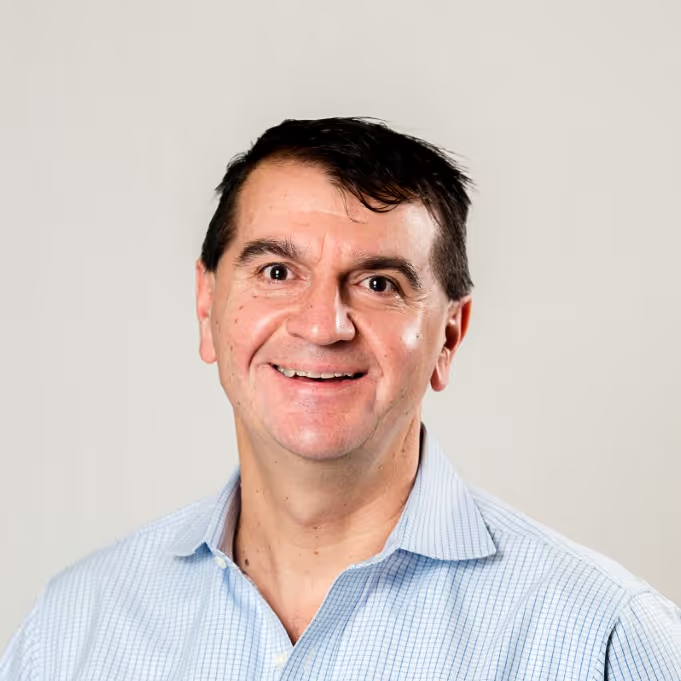
In this episode of High Agency, we sit down with Adrian Moise, CEO and Founder of Aequilibrium, for a conversation on resilience, vision, and the art of transformation. From building global teams at Ubisoft to pioneering VR+AI training, Adrian shares how martial arts, Formula 1 strategy, and a “human meets digital” philosophy fuel his approach to change. This isn’t just about scaling a business, it’s about crafting remarkable experiences, turning setbacks into momentum, and rallying people around a bold, shared future.
Adrian Moise [00:00:00]
Which one of these two cultures and organizations do we want to emulate? Part of our benefit is we bring in best of talent from all over the world. When we feel like some of the people are not only just great in their hard skills, but they are a great fit with our organization, we help these people come to Canada. And this is a big investment and they require quite a bit of support. I know from my experience to move into a new country. When you come in and you have a lot of these things already in place for you and a stable job, makes a big difference.
Mo Dhaliwal [00:00:36]
Welcome to High Agency, igniting conversations with inspiring people, leading transformative change. These invisible threads that are weaving together all the technology in our lives have a very common origin story. It's people crossing borders before they cross industries. Technology shapes our culture, which shapes our future, and the architects of this transformation are increasingly those who once called another country home. 60% of top tech companies in 2025 have at least one immigrant founder. And more striking is that among the Forbes AI50 list, immigrants founded or co-founded 25 out of 42 American firms, representing 25 different countries. And while countries like Canada, the UK and Australia are actively courting global entrepreneurs with very specialized visa programs, most recently it's looking like the US might risk their competitive edge with more restrictive policies. But the historical pattern is pretty undeniable. You have Sergey Brin, co-founder of Google, from Russia. You have Jan Koum, the founder of WhatsApp from Ukraine. You have Mike Krieger, the Founder of Instagram from Brazil. Elon Musk, of course, South Africa. You have Tobias Lutke, founder of Shopify from Germany. And Scheherazade Rafadi, the founder broadband TV from Iran. Now, these are some of the most recognizable names in the U.S. And Canada. And today we're going to add to that list Adrian Moise, founder and CEO of Aequilibrium, whose journey embodies this narrative. Hailing from Romania, and with experience spanning Ubisoft, Electronic Arts, many other massive firms, Adrian has developed a leadership framework that balances human-centered design with technical innovation. His expertise in spatial computing and immersive technologies continues to fuel his vision and his insights on leading through alignment autonomy and accountability offer a window into how global entrepreneurs are reshaping business. Adrian's passionate about enriching people's lives through remarkable digital experiences, all the while applying metaphors from formula one racing and martial arts to business strategy. Welcome Adrian.
Adrian Moise [00:03:04]
Thank you, great introduction and I am very flattered to be in the company of the names that you mentioned in there. No pressure here to bring the company to a three trillion dollar valuation, right? No pressure at all.
Mo Dhaliwal [00:03:18]
This would be the podcast. That was that inflection point. Um, so look, you know, we're going to talk about your work, um, and what fuels your leadership and how you, you've worked to grow Aequilibrium into the, the powerhouse that it is in Canada today. Um, but I want to begin with your origin story. Like as a, as a young boy in Romania, um I'm assuming that you weren't roaming around thinking one day I'm going to really make big moves in digital transformation, that you might have had other thoughts, aspirations, influences. So what brought you out of Romania and what actually brought you into technology in the first place?
Adrian Moise [00:04:04]
I was inspired by my parents and the interesting thing is they were both engineers, but they study my mom in the forest industry and my dad into the food industry. So as computer were introduced and Romania and the Eastern European country got exposure to. Computers, there was no school of computer science, there were no specialists in computer science, so they created these programs to incentivize intellectuals, basically engineers from other industries to convert. So they were bringing in, we understand these other industries, we need computer science experts, there are no such experts, so let's seed this computer science. Industry in Romania and both my parents transitioned from their verticals, their industries into computer science to the point in which my mom became, if you want, head of IT into one of these factories because these organizations used to outsource and a lot of the work including, you know, dealing with payroll or anything about. Hiring, recruiting was paper-based. So they figured, well, computers are coming up. And when I say computers, I remember in the old days when I was visiting my parents' office, there were like these fridges that were like a ton in weight that had these massive tapes. And then I was really happy to use those terminals and then to play these ping pong games on low resolution, black and white. You know this place so i said like hey this is interesting and they weren't even black and white
Mo Dhaliwal [00:06:00]
They were black and green. Oh, yeah. They're.
Adrian Moise [00:06:02]
Or black and orange. The screen, you know, green screen terminals, right? And the keyboard, like you really were exercising your hand muscle when you're pressing on those keyboards. But the point here was we saw a revolution and how computers started to have a wider adoption. At that time, I was in a math and physics high school. And there was a donation from somebody in the Western community with a set of maybe 20 or so, they were called, I don't know, personal computers at that time. And we created the, let's call it IT labs. And I was the first generation, the first 10 people who got access to this. And then there was... National schools of informatics and then I attended the first camp in there. So timing-wise I was exposed one of my parents moving from auto industries and verticals into IT and then our high school through this donation was among the first in Romania to actually build a informatics lab and that's when I said that's what I will be doing.
Mo Dhaliwal [00:07:23]
And not only did you dabble, I mean, you went on to do a PhD and then held some leadership roles in a variety of different organizations. I have to name Blast Radius because being based in Vancouver, I don't think you can meet anybody that is working in digital product or engineering or design in this city now decades on. That doesn't have some DNA or some interaction with somebody from blast radius, either themselves or indirectly from years ago. So you have some pretty pivotal roles, but it started with your PhD.
Adrian Moise [00:08:02]
Um Part of this revolution that was happening in Romania. I was part of the first program to do a master program in computer science at the School of Computer Science in Romania. So throughout my career, I've been a guinea pig in many instances, right? Like we don't know what the master program would look like. The professor was shaping the curriculum by involving us. So I just graduated five-year degree in computer Science as an engineer. And now this new program was offered as a master's. And then, in parallel, I... Got a job as assistant professor of computer science and I was also working for Ubisoft as a lead game developer and there are several elements in here that I think shaped my career because one is this duality between education and industry. I was working for Ubisoft while I was a full-time professor in computer science. And I was doing my master's at the same time. And I remember when I joined Ubisoft, my computer had the only desktop computer that had a CD-ROM play, right? So the fact that people were waiting for me to finish working so they can play games and listen to music on CD was like such a new, amazing, cool technology. And then... I felt like my job couldn't get any better because we will go down to one o'clock in the morning, play Doom on the three o' clock in the morning wake up at seven and start again. I'm still like, you cannot get any bettter than that. Well, the company was going really fast and as a professor of computer science, I was exposed to amazing, you know, students and I brought many of them to Ubisoft and and we grew the company from. About 10 people when I joined to over 120 people on the payroll by the time I left. So part of this investment in higher education, I got my master's in Romania and then I decided to move to Canada and do my PhD at SFU in computer science. My wife came with me and our plans were that I would go and study and then coming here as permanent residents. My wife will go and work and that was the original plan. The plan don't resist contact with the enemy. And then when we got here, none of those plans actually ended up being the plan of record, because in the summer, after the first year in my PhD program in SFU, I took something that was called a summer job. Our head of computer science was doing medical imaging. So we found a company in Richmond called ALI Technology who was doing medical imaging So I was designing this software that was replacing the old school ways of reviewing radiology images, which used to be do a scan. These images are printed on large film. You have these big light boxes in the radiology department. You hang the film on the light boxes and that was how radiology was performing at that time. So we thought Actually, computers can't help, can we? Move from reading images printed on film on light boxes to use computer screens. But then it was like, wow, the light boxes are so much cheaper, and then you got so much space. That doesn't compare with the hardware, the computers that were available at that time. When we're going to talk about digital transformation, some is just incremental. You saw this coming and then all you can do is to optimize it. But some is disruptive. It's like changes how, you know, it's like somebody is planning for a future thinking like forecast was going to be five years from now. These outliers you couldn't predict. Yeah. So anyway, the idea was in this 3D. These images of the human body were already acquired in three dimensionally. So the idea was, why do you have to replicate how you read film on light boxes? Why don't you look like a human body in 3D and look at anatomy, look at the heart in someone. And I had the opportunity to help this organization, which was a small startup in Richmond, and every year we're trying to get another round of investment to survive and pay the bills. To compete with AKFA, with Philips, with Siemens of the world, into this new space. And because he was brand new, despite his billion-dollar companies, he was equal grounds because we're all figuring things out. For me, it was also a benefit that for my computer science, I had the chance to design software that was competing with the best in the world while supporting my PhD research. And I was looking into interesting things, for example, using eye tracking, we are giving some tasks to, not the typical experiments you run with students, these simulations is like, I was working with real radiologists and say, listen, how is the design of the interface of the radiology workstation affecting your speed and accuracy of interpretation? Because when you have these light boxes, there is no menus to... Manipulate rate orgies are just laser focused on reading the anatomical components finishing that exam as accurate and fast as possible Moving from that to computers, especially in the early stages. It was like significantly more work and relation and so on so I Demonstrated so my research that the design of the interface matters a lot and the more difficult is to study that you are looking at the more cognitive workload. Redirect towards manipulating the interface of the computer instead of spending time reading the medical imaging. That helped ALI technology win some massive deals and they were acquired by McKesson Medical Imaging. I saw some of my colleagues who were working for this company cashing their stock options and bringing portions into the parking lot. So, that was my first part of not just a digital transformation, but It was a game-changing experience, and taking something from a startup that was nobody even know where Wishmond is, to actually putting this small company on the map while competing with the behemoths of the world.
Mo Dhaliwal [00:15:23]
There's an interesting thing that Malcolm Gladwell talks about in the David and Goliath story, right, because, you know, in David and Golieth, the classic sort of parable is that there was this bigger, stronger opponent. David defeated him with just a slingshot. And Malcolm Gladwell does this great breakdown where he actually looks at how slingshots were used during that era. And he looked at Goliath and said, he probably had some sort of disease that kind of gave him gigantism. And there's some evidence that maybe his vision wasn't great. So you have this big hulking sort of being that couldn't see or move very, very well. And he said, David had what was the equivalent at that time of like, a gun, right? Highly accurate. Really really you know incredible force that they bring to these projectiles with their slingshots. So he said actually it's not really an underdog story because you have this big hawking beast that couldn't move well and David at a distance just kind of shot him right. So you know I'm reminded of that example when you're talking about the company was called ALI. ALI technology who became McKesson Medical Imaging. Yeah and it's actually funny kind of hearing that side of the origin story because from back in the day I have friends that actually worked that McKesson in those early days. Um, but yes, there's massive behemoths, like there's the Philips of the worlds and they're doing all sorts of stuff and imaging and resourcing. Uh, but there's huge advantages to being a small nimble team, right? And actually the behemoth can do what you can do because like you said, you're working directly with radiologists. You're working in a very agile environment, right. So it's direct information. You're probably iterating daily. Whereas some of those behemothes might be waiting for some quarterly report or some long study or analysis to show up before they make any sort of iteration, right, Um, so was that sort of where your exposure to and sort of passion for agile as a way of working and managing showed up or, or where did that kind of come in? Cause I know you're a big proponent of agile. Totally. And.
Adrian Moise [00:17:21]
You're right, sometimes speed and agility trumps this. The power of these large organizations. I remember one of our flagship clients was a radiology clinic in Beverly Hills. So everybody wanted to go visit this client. So I can tell you that. Very high tech facility. Our software was really still in early phases, call it like an advanced beta program, and this was an early adapter client for us. So we were still between the software, but I was sent there as a team lead to support the radiologists, but I would actually see them. What was the problem they were having? And exactly like you said, I would see what the radiologist was doing, what's he struggling with, and then ask him some questions. One is like it was something benefited in my research because I had a viewing to. The user that I was researching, but then I was calling my team and say, Hey, here's what's happening. You know how this is going like this in this, can we change that? And the next morning we had a new build. So for the radiology surprise, I just told you yesterday and today this is already implemented. I talked to this other company. It takes six months to process inputs and then another two months to send the facts and basically direct this and then like, Oh, this is going to be on the rubber for next year and you already implemented it. So guess what, one they had to select out of this pilot implementation, which one to work is like, I want these guys. My voice matters versus, I don't know what happens with my input when I talk to these big organizations. So we want, I remember the biggest thing in the history of the organization who propelled them to go from a company who was serving a small ultrasound department to being the company to beat in multi-modality. Radiology Interpretation.
Mo Dhaliwal [00:19:19]
The transition from research to actual industry application though, and I've got to credit you for this because it seems pretty incredible how fast moving you were coming from your research background directly into industry and sort of creating product, creating change quite rapidly. But there's a bit of an anecdote in your story about moving from perfection to progress. And really seeing that in your son's experience in baseball. That's right. So were you a perfectionist at some point that had to kind of reform, or were you always, you know, of the nature that you were happy with progress as long as it was continuous and iterative?
Adrian Moise [00:20:05]
It was a treat that I got from my mom who was for her, the bar was very high, but I realized that perfection is more like something to aspire to. Um, and then it's extremely expensive. So it's think about is you pay for uptime and saying, okay, what kind of service, um, do I want the, I want 99% uptime if you say, I want 99.9, you just double the cost. And you sound like How come zero 9% cost me for the first as much as the first 99%? Yes. Because as you raising the bar high and higher, the effort involved to basically do that is like very toxic. And then you need to ask yourself, does it really matter? Right. And I know when products are being designed and then you're looking for a niche, you can come out, Oh, my algorithm can help this. Let me give you an example. We transfer money from A and B and then like, okay, um, our application can do this in my millisecond. It's like, if you do this in a tense of a second and somebody does it in a millisecond, is anybody human being who will notice that difference? So other than your bragging rights, like what is the business value for this? So then you're looking into what are the things that matter as opposed to like, I can just improve that. It's you got to choose which one. Are actually, well, right now, this is not good enough. If it takes you two days to send you money, thank you for paying for my dinner, let me pay you back. And it's gonna take a week for that one to get, is he probably like, hey, that's not good enough, but going from tens of the seconds to a microsecond is, that not a, so I had to work on myself, one, because otherwise I was feeling a stress and disappointment that I'm not perfect. And then to admit, is anybody perfect? Do you need to be perfect? And then one being more kind to yourself, but also how I interacted with other people. I had to change to figure out with my son's story, him going into baseball kind of when he started, some of his friends were playing baseball for two or three years. So he learned really fast, he was very coachable, but he could not make in that first whatever season, which was like four months or so one, what other people learned in three years? But the interesting thing for those coaches that inspire me is at the end of the season they got one of these baseballs and everybody signed the baseball and they gave it to my son. It wasn't called the best player. It was called the most improved player. They'll change how I approached awarding the highest bestowing the highest award in our company was the most improve player. And that was one of these awards that we did in our organization too. You have to look into what challenges this person had to deal with, where was the origin, where do you start and how much you progress as opposed to this person is already doing something very awesome and then got a little bit better. So which one of those improvements would you award and respect more, right? So I chose to go to the most improved player.
Mo Dhaliwal [00:23:31]
Is that something that was kind of baked into the founding of Aequilibrium as a software company, or is that something you had to kind of learn as you went?
Adrian Moise [00:23:41]
A bit of both. So I feel like most founders bring some of the values into the organization. Even sometimes it's explicit. All of the value is. And sometimes, you know, it's like, maybe I haven't articulated that, but that matter. So it was one of the points of inspiration. I look at people. Part of our differentiator, we are calling, we accelerate your career. We'll help you get to become your best self faster than anybody else. And we had people that we promoted and increased salaries and job descriptions three times in two years. More recently, I actually read this book called High Potential by Adam Grant, and it's like. He actually formalized this, you know, one way to look for like what actually makes a great employees through research, not just Godfrey. Oh, I think this is like not the pedigree, which universities have you attended, not what you have on your resume that you've done in the past is not necessarily transferable to how successfully be in the new company. This idea of hidden potential basically people that may not have the same skills as another person today. But man, their trajectory to grow is this much. So we have several of our employees that instead of hiring them for what they know now, we particularly focused on actually this person has a lot of potential. I like to believe that I was able to identify and support these type of individuals to accelerate the career, while making a big impact for both Aequilibrium and our clients, and we love that partnership.
Mo Dhaliwal [00:25:32]
And you guys have quite the diverse workforce at Aequilibrium. So what's the composition of the company? What's the makeup?
Adrian Moise [00:25:39]
Where's everybody from? I think, for example, our entire executive team, they are all immigrants coming from different countries. I believe that diversity of thought is one of our differentiators. Enabling this with advanced collaboration tools. And this can mean from different gender, different backgrounds, even bringing into a conversation and people with a specialization that I mean, being like, why is this person even attending this meeting? If you have people with the same background education and perspective, they all gravitate towards the same group thinking. We all have the same ideas. We all used to sort of like, this is what's the norm. And then we all accepting this is kind of as a given. When somebody Comes in with a different background. They come in like, okay, why do you take that for branding? Have you thought about this? And I'll be like, hmm. One, you need to have a culture in which you want to allow these voices and then feel comfortable as opposed to like the bigger your paycheck or more pompous your titles, your bigger the voice. Instead is looking into. How do you enable this type of interaction? I actually want to share this story. I was on a trip at Blastradius to visit two of our key clients, Starbucks and Microsoft, in the same trip. So we went to Washington State, to Seattle, and then in the the same one day we visited Starbucks and one day, we visited Microsoft. When we visited Starbuck, we met with the Chief Digital Officer. We want in this meeting When half a day I was meeting, it wasn't clear to me who was the Chief Digital Officer, didn't stand out. He wasn't a person. Everybody was basically deferring to him and so on. It was such a flat organization, collaborative environment. Everybody felt very comfortable. The next day when we went to Microsoft, there was one person who was sitting on the head of the table. There was one question that everybody was deferring too. There was one person saying... I tolerate you being in the room, but I'm the big gun. And I'm telling kind of what's going to happen here. So I'm looking at, hmm, which one of these two cultures and organization do we want to emulate? We have a lot of people, part of our benefit is we bring in the best of talent from all over the world. When we feel like some of the people are not only just great in their hard skills, but they are a great fit with our organization. We help these people come to Canada. This is a big investment and they require quite a bit of support. I know from my experience to move into a new country. So when you come in and you have a lot of these things already in place for you and a steady and stable job makes a big difference. And then we are meeting at our home. We're doing this type of in-person get together with the team and, and the people were sharing their stories. I met somebody came in from Mexico, I met them at the airport, took them to the area B and then make sure that they landed well and they're calm and they find a nice place. And so once people from Brazil, people from Turkey, you know, so I think, um, this change moving to a different country is quite a game changer. Some, including us, we had to basically do this by ourselves. We didn't know anybody in Canada when we came in. So acknowledging the struggles you need to go through and the fact you need you adapt to a new culture, new way of living and so on. We're trying to bring the right people to Canada. I think this is one of the competitive advantage Canada has and needs. To basically continue to have, especially given what's happening in the United States. And I think Aequilibrium is doing a particular job in selecting hardworking and amazing individuals to come in and help us improve productivity and then innovate and grow.
Mo Dhaliwal [00:30:06]
Is there, I mean, diversity or perspective is definitely important. You want people that are part of a team where everybody's pushing in the same direction, but they see the same problem, they see this same opportunity from very different angles, right? Like diversity, absolutely. But is there something else that's inherent to the immigrant story that just makes immigrants really good hires? Like, I means, because you hear it as a passive statistic in so many companies that say, oh, you know, we have a really diverse workforce representing this many countries, et cetera. But that seems like a passive thing. Right. What is the immigrant experience enabling? Like, what are the attributes of these people that actually cause them to be successful and the companies and the teams that they join to become successful?
Adrian Moise [00:30:52]
A lot of the people that we work with have this mentality as opposed to, well, let me dip my toe in the water and if I don't like it, I can just go try something else. These people come with a state of mind, I'm going to make it work. You got to make a work. It's like, sometimes it's like that situation in which you burn your ships, you land it, there is no going back. So you got to basically stick the landing. So, I'll see you in the next one. Well, I'm going to New York, my daughter got us tickets to Hamilton, and it was one of the greatest experience to watch that music and so on. I love the lining there. Immigrants, they get the job done, right? So I think we see a level of ethics and commitment and similarly looking into how hard it was for us to do this all by ourselves. Supporting them in the process. Builds more trust and is like, because in the end, people don't work for a company. They don't all work for law, but they work for other people. And they're looking like, hey, these are good people. And then one thing is to give a glass of water so when you're at home and you have everything, one thing to give up a glass of water for somebody who's dying with thirst. And appreciating, you know, the fact that you make a difference literally changed the life. Like we had people saying to us, For me and my family, I have my I was dealing with all kinds of problems in where I came from. And now I can breeze my family safe, you know, it, it made a difference, remove like a big weight on their soul. And then they are very appreciative for that. So I think it builds long-term relationship like this.
Mo Dhaliwal [00:32:49]
So something just kind of became apparent to me, actually, as you were sharing that, like the make it work attitude, because it's not tied to any industry, frankly, it's in any role that an immigrant takes. And I mean, I've got an interesting perspective on it because I'm born here, right? Well, my parents were immigrants, so I've I've that sort of, sitting in the middle sort of thing. But as you're sharing that I just realized that there's kind of a metaphor in this because New immigrant, as joining a company in a far away, in a different place, it's kind of like the ultimate agile story, right? Because when you look at like, let's take Canada, for example, anybody coming from Asia, Eastern Europe, et cetera, that's grew up in a completely different environment. When they come here, they're suboptimal from day one actually, because culturally it's different, language that might not be as proficient, they might not as fluent with, you know, how to kind of get along in the society. But they're really down to get started in an imperfect way. And then day after day, it's continuous improvement, right? Like my parents, my mom especially, I mean, they didn't work in technology by any means. My mom's first job when she came to Canada, I mean she worked labor, like they were on farms doing manual labor all day, every day. And I kind of look at the iteration of her life, the English improved. The roles in these various places improved. Eventually she started taking night classes, over time became a nurse's aide, started working as a home care support worker and had a career there for like 20 years. And if somebody had stopped her and said, well, you know, you're imperfect for Canadian society and you don't have this, that, the other to even get started, the story stops right there, right? But theirs was one of continuous improvement that started in the seventies. And I'm just kind of realizing the comfort of like my generation that was born here, right? Because I think we have a bit of a waterfall mentality, right. I'm gonna do this step and then I'll get this then I'm going to do this stuff and then we'll get this and perhaps a little bit less hardworking and perhaps, a little less adaptive than that generation was. How are you, or have you had any sort of reaction to the change in sentiment over the last couple of years? Because we've had a very diverse team at Skyrocket. It's a small team, but whether it was 12 people or 20, there'd be myself and maybe two or three other, quote unquote, Canadians on the team. And there was times when we had people that were representing a dozen different countries and spoke 14 different languages here, right? It's wild to have a team that's that different. But there was arrows like that that we went through and it was cool. We had all the advantages that you named, the different perspectives, different ways of solving problems and just kind of coming together. There's a different sort of mood politically, culturally that's going on. You know, the, it's very apparent in the US who's driving that and how it's coming about. But I do feel like that's kind of infecting a bit of Canadian culture as well. But what's been your reaction to it? Has it affected, you know, not your hiring practice, but has it affected your sort of commitment to this area?
Adrian Moise [00:36:02]
I don't think so, when you have these external pressure, you need to have a role model and your right leader of a country can make a big difference in terms of how the other leader is economic and someone will follow or not. You have the government, you can have regulations to basically support certain groups and so on. There is a risk that pendulum swings too far. And then some people start to be like. Okay. From being supportive and positive to that, is that too much? The other thing is sometimes even when you try to do something good, you may end up backfiring, right? So if you're looking for diversity inclusion and then you have a quota, I just need to hire people with this profile just because I got some numbers to hit, then it's for the wrong reasons and then. You also want to hire people who are actually can be successful in the job and good at the job, not just because they meet a certain profile. So I do feel like certain community and social and economic aspects being. D and I, you know, diversity and exclusion, or, you know, being about greenhouse emissions and someone took a step back with some of the changes that we're seeing. South of the border, I feel a Canadian have been affected a bit about this because the U S used to be the big brother, but now it's not that brother that actually looked positive over your shoulder is more like, uh, you know, what The relationship we used to have in the United States has changed. So now people are like, I don't have to be as much influenced and inspired by what's happening there. So yes, I'm seeing that there was a momentum that basically almost kind of tempered and there was risk to actually see a bit of a going back, but the from the United States, I think, will... Be much more. Kind of minimize if you want, given the way that the Canadian and U.S. Relationship, especially at the leadership level has continued to evolve. So back to your question, it has not affected how we proceed. We continue to focus for top-downing for more of the world. Our company is working fully remotely and our clients are all over the world, So we continue to look for. Top talent internationally. We do prioritize hiring local especially right now supporting Local communities, local hiring, local businesses is top of mind for us. The same time we look for other people like ourselves who could actually complement the team well. And this diversity in backgrounds is still a key differentiator for us
Mo Dhaliwal [00:39:21]
I mean, it sounds like an Aequilibrium. You've got a lot of the right stuff really, really figured out so much so that you develop this AAA leadership framework that I mentioned in the intro. What are, like, are you still, are you still learning new things? Or do you feel like you're kind of at that 99 to 99.9% mark or do you go through years where you're still surprised by people and you're still learning hard lessons?
Adrian Moise [00:39:49]
Absolutely. So the AAA, and I'm going to mention that because coming from the gaming industry, we used to have games that were AAA and not a different connotation. The AAA stands from alignment, autonomy, and accountability. And it's our leadership framework that basically is about ensuring starting first, are we having a shared vision? Do we have a common understanding of what success looks like? Then hire the right people. And enable and support them and give them the autonomy to get the job done. But autonomy is useless unless you have accountability. Hey, are we going in the right direction, are you having the right speed, do you need any help? We work into the framework, but by no means we claim we reach perfection. We have this hypothesis in terms of how success is being measured. And sometimes we open it for feedback. Hey, I will walk in the walk and it may be, we always have to have that being self-conscient. Hey, am I behaving always like this? I certainly have a lot of room for me to look at my blind spots and see how might I support and enable the team more. I have a tendency to talk a lot in the meeting. So at least I'm aware about this. And I'm trying to figure out, okay, especially right now you have this AI taking meeting notes and so on, like, Hey, you spoke 40% in this meeting. Okay. How do I get to 20% and so, and so I'm looking for example, for me to work on listening more and then enable people more. And even if I feel like this is not the ideal solution or scenario. By empowering people to take risks and run with something they're passionate about, it's more important than going with my way. One is there is no guarantee my way, which probably work well in a different situation, is immediately translatable here. And then sometimes as we discuss, if I believe my idea has a score of nine and this has a school of eight, but this person is really looking to move into this leadership for all. He's really passionate about this. Why don't I enable them to try their arm and go with the exactly. And then part of that hidden potential help this person to be more comfortable into this role. And I think that oftentimes give us a bigger win than going with what I saw at initially could be a good idea.
Mo Dhaliwal [00:42:27]
I'm gonna bring up one of your passion areas just because in our first conversation, I think we were a minute into it by the time you were telling me about how passionate you were about this. How would you compare the way you lead and the way your bring together your team to a Formula One pit boss?
Adrian Moise [00:42:49]
So I'm passionate about cars in general, but Formula One is like the epitome of racing and everything is fine tuned to perfection. There are only 10 teams in the world driving here, 20 drivers, and the design, the strategy is amazing. Um, if you look into one of these pit stops when this thousand horsepower car comes in into a pit to change all four tires and then that happens in two seconds. The career like really there are some of these photos that show these 15 or so people around the car everybody you know perfectly choreographed that everything is done again and again and safely but that's only one part. Because you are so hard to shave like half a second. And then you may basically lose a full second because your pit spot was mediocre. So when the margins are so small, every one of the details matters. But the other thing is interesting about Formula One is to win, you really need to bring together strategy, design of the car and the aerodynamic and then. Technology, which is the engine, the components, the transmission, and so on. The same ingredients are required to succeed in for Aequilibrium. So we bring the same elements together. So I'm inspired what they're doing. Everything has to be coming together. When one of the Formula One drivers takes the trophy and we won and then gets the interview is like, thank you to the team. It's not just them. It's the people who are at the factories and help build the latest parts that helping here is the strategist who helped them on like, Hey, when you come in, what tires, um, it's the engineer that is in contact through the entire race. They collect terabytes of data after each race. They have huge amount of sensors that provide real time information to the driver into the mechanic about how the car performs. So this is not. God feel I think you should maybe step on the gas is like they know every fraction of the second you losing by taking a curb or like, you know, lifting too early on, on, um, the accelerator. So everything is really well monitored and compared. And the other thing, these races really typically happen every two weeks. So in the speed of agile develop on this idea, but two weeks sprints and iterations, you need to go from like. My car is doing well during this race and then somebody else will win the other race because they got the best adjustment between the tire strategy, the weather, you know, the fast corners and so on. So there is no guarantee for somebody, oh I won a race then everything is going to be peachy. The competition is very stiff. It doesn't matter, like, while every race matters, it's like, how do you go and improve from race to race? And some of them are basically saying, okay, we're going to stay competitive in this race, we're not going to win. But we're building to that. And we're seeing some of these teams that are coming from being third or fourth on the grid starting the season to becoming the dominant player before the end. So those incremental, so it's supposed to be imperfect from the beginning, it like that incremental progress. It's what takes you from third to second to actually winning.
Mo Dhaliwal [00:46:38]
And this is what you're.
Adrian Moise [00:46:39]
Talking about with your team, this is what you're showing in your leadership. Even like this situation, this sprint, we were like this, hey, how do we prepare for the next sprint? And looking at these retrospectives, we're looking into, for example, what costs friction for us to get more speed? What do we need to do? What's taking away from that? What's slowing us down? So not just discussing what are the good things because we need keep those and do more of it, but also like. Where can you shave that, you know, at a tens of a second that will take you from second on the grid to.
Mo Dhaliwal [00:47:19]
What do you think was the hardest lesson that you had to learn when you're trying to bring people into this way of working and this way being?
Adrian Moise [00:47:29]
The realization. That the top teams don't necessarily have. Top hard skills. If you score those person who is the top mechanic, who is the top, it's how you choreograph these people together. And because everybody to get there is in amazing top shape, the winners are the people who can put all these pieces together. We saw companies like becoming Ferrari or McLaren or Mercedes. They got lots of experience, lots of money. When this choreography is not done properly, they go from like, you just won the previous race and everybody agrees you have the fastest car on the track to you didn't finish the race or you are third on that. So how is that possible from like the race is yours to win? Basically, not being even on the podium, this is kind of the approach of like what makes like a great symphony orchestra is like not having the best soloist in there, but are these people in sync, right? Because if a person is just a second behind, it's like that's not going to sound well anymore. I like it.
Mo Dhaliwal [00:48:51]
I like everybody.
Adrian Moise [00:48:51]
Everybody else is doing a good job that one person and so on not being in sync. It's playing the same notes It's just a little bit Off right then then the entire You know symphony goes into a cacophony of notes, right? So so sometimes the margins are really tight and That keeps everybody on their toes
Mo Dhaliwal [00:49:12]
So what are you doing next with your team? Like what's the next sort of horizon for Aequilibrium to push to 99.99?
Adrian Moise [00:49:21]
A few years ago, I was part of this disruptive change at Electronic Arts to build a mobile gaming division. So we started with three senior managers and then in six months we had 120 people, seven titles to launch, the first titles ever in the world to be launched on Nintendo DS, Sony PlayStation Portable. So moving into this large billion dollar company from the top producer of gaming and entertainment on the big screen TVs. To the new small devices that nobody has seen and nobody has produced games for. Spatial computing, or this industrial metaverse, it's the next frontier. I was at a conference in California a few weeks ago, and the theme of the conference is that. Virtual reality is going mainstream and that virtual reality loves AI. We've been on this bandwagon at Aequilibrium for six years now. And some people will be like, dude, it was too early, you and, it was you and Meta who basically said, we're going to hire 10,000 developers. We used to be called Facebook. Like they changed the name to Meta. You're going build the Metaverse and so on. And yeah, I didn't quite produce the results they were hoping for. In the short term. In short term, but they have a vision that the next gen of interaction will be here. Many years ago, if somebody would be like, Oh, you need a website, what's a website, or you need to have a mobile app. It's like, what, what mobile, right? CDM visions that this industrial metaverse is a $13 trillion opportunity and the evolution of the internet. So the same way right now, all of us are wearing a phone. This will be the next phase in terms of bringing together the spatial computing and this combination between virtual reality and the platform, the hardware that are getting competitive right now. The addition of artificial intelligence, because in this metaverse, you can talk to avatars and you will not know if there is a person that has a conversation or Mo has a digital twin in there that basically acts like you, behaves like you speaks like you. So we can customize these experiences. For example, we get the persona from a client and say, if this is, if, this is member is an example of interaction with the with a customer and you have these archetypes called personas, we can get these characters, these avatars into which variety to behave like those persons that, and this will enable interactions for education, for training at scale that helps you build muscle skills because this muscle memory, it means you have to do that. So you memorize how to react. Versus just watching somebody's video. How you do it at that, you know, think about it You watch You know formula one. I'm a big fan staying for three hours in front of a computer It's not gonna make me a great driver if you watch Roland Garros, you Know people playing top-notch tennis it's not going to make me be a good tennis player But if I actually swing the rocket and then I play that in the safety of my home at whatever competitive level Is challenging for me that would make me better player, right? So There is no doubt in my mind, for example, in education and training, a few years from now, this obsolete PowerPoints will be replaced by this experience in which you are part of the experience as opposed to somebody's talking at you. So my son is starting to become a doctor. In his studies, he will see a change by the time he's going to finish his education, in which instead of coming with those transparent annotated slides to PowerPoints, there will be interactive experiences that will prepare these kids for the future, especially right now with AI disrupting a lot of these jobs. The job of the future will be so much different. So how do we teach this younger generation to be ready for jobs that don't even exist today? Will be very different 10 years from now and down the other day. Exciting times. Super exciting. We're living in the future. I think the next 10 years will bring more change and disruption than probably the last 20 years. Well, Adrian, if
Mo Dhaliwal [00:54:14]
If somebody wants to learn more about you or Aequilibrium, where can we send them?
Adrian Moise [00:54:20]
I'm active on LinkedIn, so that's a good way to contact me, but also our website Aequilibrium.com. It's a great way to learn more about us, about our story, about customers and the solution we provide and then get in contact with the team.
Mo Dhaliwal [00:54:39]
And I have to say, this has been a great conversation. We're gonna put the links in the show notes as well, so people can find you easily. But you've got to spend more time talking about your leadership philosophy. I think it's so cool. I think the parallels you drew with like F1, you know, diversity in the immigrant experience, I just think the world needs to hear a lot more about this.
Adrian Moise [00:55:00]
Thank you so much for creating such a great forum. I really enjoyed the conversation and the flow of information on both sides through dialogue. And it was a great opportunity to meet you and then get a chance to share my story.
Mo Dhaliwal [00:55:16]
Awesome. Thanks, Adrian.
Adrian Moise [00:55:17]
Brilliant. Thank you.
Most of America’s Top AI Companies were founded by Immigrants
David and Goliath: Underdogs, Misfits, and the Art of Battling Giants by Malcolm Gladwell
Hidden Potential: The Science of Achieving Greater Things by Adam Grant
Leadership and HR Insights from Formula One (F1) Racing
Citi says metaverse economy could be worth $13 trillion by 2030

Get our latest insights on brand transformation and digital innovation delivered monthly. Join forward-thinking leaders who are building momentum.
We’re ready when you are.