The next move is yours
We’re ready when you are.
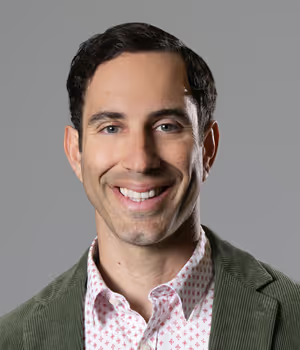
Mark Rabin [00:00:00]
Humans like we're pretty simple. I think we respond to pain. That's it. Like I don't, I don't think there's much more to it. It's not that complicated. Like until we feel now there's, now we can plan a hundred years out, we can do this stuff. But I think the general population unfortunately has to somehow have some sort of stimulus that, that helps, you know, refocus them because otherwise we're not going to do it. Like how many hurricanes have to pass through, you, know, the south or anywhere. To, for people to be like, oh, okay, you know what? Like maybe, maybe we shouldn't build our McMansion literally on this little piece of sand in Florida.
Mo Dhaliwal [00:00:52]
While AI and electric cars grab headlines, a profound shift is happening beneath the surface of our energy landscape. This year, 2025, is the first time that investments in clean energy technology will surpass upstream oil and gas investments. It's a watershed moment that few predicted would come so soon. Now, behind this transition lies a perfect storm of innovation and necessity. Solar photovoltaics now count for half of all clean tech investments, while a new wave of power-hungry industries is creating unprecedented demand. Data centers alone, fueled by this AI revolution, are requiring an additional 44 gigawatts by 2030. That's enough to power millions of homes. But this isn't just about building more solar farms and wind turbines. The race is on to develop technologies that address this sort of Achilles heel of noble energy. Irregular and intermittent nature. So green hydrogen, long duration energy storage, and AI-driven grid optimization are moving from experimental to essential as our energy systems transform. So today, we're joined by Mark Rabin, the visionary founder and board member of Portable Electric, which is pioneering mobile renewable power solutions since 2015. Now with over 23 years in the energy industry, he's transformed portable electric into a global leader. Mark holds advanced degrees in earth sciences, energy economics, and an MBA in technology and innovation. He's currently serving as president of Carbon IP, and he's developing battery-grade graphite from trees and continues consulting and advising early-stage start-ups. He's a passionate climate tech advocate. Mark also co-hosts the Tie-In podcast, which is discussing sustainability and innovation while mentoring emerging leaders in the clean energy ecosystem. Mark, thanks so much for being here. Thank you for having me. I mean, your background and education, obviously very underwhelming. Obviously, you're not a high achiever at all. But before we kind of get into your work, portable electric, carbon IP, the work that you're doing now, always really curious about why people set out on a mission. And I don't want to put words in your mouth here, but there's a theme to your work and your interests from your education to what you've done to this point. It's seeming like you're on a mission. So I'm really interested to learn, obviously, about what brought you to this point in the companies you've developed and the work that you're doing. But before that, I'd be really curious to hear about when it dawned on you that... This is an important mission.
Mark Rabin [00:03:34]
It's all an accident, just to be clear, like anything, right? I mean, you know, we start out with this vision of like, I'm going to be over here, and this is what's going to happen. And then you're like, oh, OK, well, I've got to do this for some time, and then I've got to struggle a little bit, and I've gotta go here. So I started off as a geologist in the oil business. And you know it's like, I always joke that I wasn't in your bio at all. And I was like. Everything I learned about the earth, I actually learned from being a petroleum geologist, which is kind of interesting, right? It's kind of weird, but I sort of like learned how to understand the earth and learn how to like building an earth whisper, you know, listen to the earth. And I also understand earth processes, but it was in the, the, the dark Northern BC woods, drilling these, these oil and gas wells, um, that I fell in love with the energy transition. And this is now, we're talking early two thousands here. Right? So it's a long time. And I started to read all these books on the end of oil and the hydrogen economy and renewables and you know, what was going to, what was on with the planet around us. I mean, cause that's, that's the biggest thing, right? I mean if we just look around, we can see that things are sort of out of balance and then even humanity here on the planet, we're all sort of, out of bounds. Um, so I started going down that, that rabbit hole, um, while I was in this oil rigs and That's when I was like, okay, I, my passion wasn't being a geologist, but then I realized, I was, like, oh, wait, this has sort of given me the key to understanding the next phase of where we're going from an energy perspective. I started calling up all the top energy mines in Canada. This is early days. And they were, like you have to leave Canada to study energy. And I was oh, okay. Cool. And so, that's when I found... The top energy Institute in, in Scotland. It was actually in Europe. Uh, and it was called the center for energy, petroleum, mineral law, and policy at the university of Dundee. And I was like, great, I'm in, let's go sold everything and, and did that. And that's what sort of brought me into this, you know, into this sort of new awareness of where we're going from an energy economics perspective. And, and I loved every minute of it. You know, You know when you're in those moments where it's like everything is flowing perfectly right. And there's, there's no resistance. That was, that was one of those moments. Um, so that's sort of what, what kept me on that, started me on path. Um. But the economy tanked in 2008 and I actually had went back to the oil business for five more years. And so it was a bit of like a rough adjustment, but then I also was just like, look, I'm, I, I I'm all in, I know where it's going now. It's a long game as kind of your intro. Like this is, this isn't, we're not at the like middle point of an energy transition here. We're actually at the very beginning fart of an, of a changing our entire global energy infrastructure. So I was like, okay, I consoled myself in that stuck it out for five more years. That's when I, that's when like, I was, like, I got to get out of here, uh, 2013. And that's what I went and did my MBA and focused on. Uh, energy technology and information technology. And actually my first business out of that MBA was doing energy in Africa. And it was in South Africa in Namibia and we were doing these little hybrid solar generators, like little power systems. And, um, and that's sort of where I set the sort of the wheels in motion for what was to come.
Mo Dhaliwal [00:07:18]
So you you said in 2013 you just felt like you had to get out of there. What was the motivation at that point?
Mark Rabin [00:07:25]
My heart and soul just knew that my time was done with my work in the oil business. And I knew it from the very beginning, but I learned as I sort of matured that I'm like, oh, here's a spigot with cash flowing out of it. And if I wanted to achieve what I wanted to achieve, like I was like, okay, I need to figure out how to work the system. And so for me, that was me working the system, you know, is like learning how to like. Work the banking system, how to make money, how to like show up every day and look good and be a part of a team. I've only had one real job in my life, like full time job. That was when I was in the oil business for five years. Yeah, it's been an interesting journey though, because what's interesting now is all of the energy folks that I'm interfacing with back in the day are all now towing into the world of renewables and off-grid clean energy and different, you know, diversifying.
Mo Dhaliwal [00:08:27]
Well, I mean, it's a necessity. It's apparent where the world is headed. It's a parent where the transition is headed, so I think it's very much a practical, still a very capitalist decision to get out ahead of it. I'm not sure if he was from the Saudi family or a minister, but I remember there was some member of OPEC years ago that made this comment. He said that the Stone Age didn't end due to the shortage of stones. And it was, I mean, such a profound statement to make, but he was speaking to the oil transition. He's like, we're not gonna run out of oil. The transition will happen beforehand because it has to, right? I'm a little curious about when you talked about being a geologist and at that point kind of realizing that you had a connection to this thing. Like, was it from a connection to the land, was from a collection of actually like almost on some level, like interfacing with the earth in a really like deep and interesting way? Like, what was it that kind of connection at first. The reason I'm asking that question is, you know, there's a bit of an interesting phenomenon where a lot of people don't know this, but here in BC, there are a number of different organizations that work on conservation of salmon habitats. And you wouldn't think this because it's almost counterintuitive, but they were all founded by fishermen, right? People that actually fish for salmon and therefore had a really intimate connection of these spaces. Therefore understood kind of how sacred they were and then wanted to protect them, right? But it is counterintuitive. Nobody would think that it would be a fisher that would want to go out and create.
Mark Rabin [00:10:06]
Well, it's just like farmers are seeing the effects of climate change far before anybody. Um, for me it was, it was a connection to humanity. Not, not, not the land. Um. The land will be fine in the long, the long run. It's,
Mo Dhaliwal [00:10:21]
Once it shakes off the people it will
Mark Rabin [00:10:24]
It's us that won't be okay. And something I've always said is sort of like, any civilization intent on surviving would not be doing what we're doing. Holy shit. That makes no fucking sense, part of my French. You know, there's no way, right? Everybody knows. Like that's that, you know, it's like the gigs up, everybody knows. It's just, you now, we've got competing interests that are just trying to. You know, just continuing to, to hold onto power. But like for me, it was about, about any advanced civilization needs to be doing something differently if we're going to survive on this planet, right? Or if we were to be visited, maybe they're already here, but by, you know sort of extraterrestrials from somewhere that could be part of us wherever they wouldn't be, you, know, burning. Like rocket fuel, right? That's not how they're getting around. So I'm just like, that's what got me really interested in this and also that we have the technology here. There's always that saying where people are like, well, the technology's not good enough. Like, no, no. It's pretty good. It's good enough!
Mo Dhaliwal [00:11:36]
No, I mean, and there's breakthroughs, it sounds like, that are showing up all the time. And was there any specific breakthrough that kind of led to the founding of portable electric, or was that more you heading out in a direction and saying, okay, we have to do this regardless, and we'll figure it out on the way.
Mark Rabin [00:11:54]
So a couple things. The first one is part of my also background is parties, throwing events. Oh, we have that in common. I used to do that. Yeah, I love it. I love creating community. I love bringing people together. So it's the first thing that you need when you're doing an event that's sound and lights and music. And how do you power that? So you have a generator. So if you go to festivals or Burning Man, for example. Burning Man, there's a generator. Every 15 feet. I don't know, like it's literally a generator everywhere you go and they're like buzzing and they're so inefficient and making noise and polluting. And so that's kind of what I've always, I was already in that world. And then from the previous business is called Zolaire doing, doing these little portable power systems. I actually got to observe how humans wanted to move a little power system around. And so I, I sort of connected that. And with these portable generators that I've already been used to using. That's, and I was like, okay, wow. I want to try to rent an industrial grade renewable power system. Like I don't want to rent a generator. I want rent a silent generator, a battery system. And I couldn't do it. So that's when I was, like, okay, the technology exists for me to create a product. So it wasn't, the innovation wasn't in, you know, the battery technology that I was doing or anything like that. It was in how I was packaging this and how I presenting it and how. As a user of the product wanted to move it around.
Mo Dhaliwal [00:13:32]
Mm-hmm.
Mark Rabin [00:13:33]
Hence portable electric. So it was around like just really understanding humanity and humans and how we wanna do things. Like this is a human problem. Like this not an earth problem. This is not, none of this stuff is like it's all, it's our own creation and we're gonna have to figure out a way forward through it.
Mo Dhaliwal [00:13:52]
I wasn't expecting that I didn't think that the initial aha moment would be around parties and wanting to create portable energy supplies for them because I actually feel that really hard because I did a bunch of festival production years ago and outdoor events similarly tying into power would be difficult And if we ever want to do something interesting or creative big noisy gas-powered things
Mark Rabin [00:14:15]
tethered to it.
Mo Dhaliwal [00:14:16]
Yeah, we're trying to tuck them away and hide them somewhere so that the buzzing, you know, noise isn't bothering us. But I didn't have the wherewithal or, I guess, the education to go away from that and say, oh, I need to create a power device and create a market for that.
Mark Rabin [00:14:29]
This is the thing though, 99% of innovation comes from something that you're doing, right? That, you know, right. Very little as we are sitting in the bathtub and you're like, Oh, I'm going to invent this thing. Um, so that's kind of what, what came, what happened, but I'm also just standing on the shoulder of giants. I mean, there's so many amazing innovators in the space. Um. And I'm very fortunate that a lot of them are my friends. Um? So it's very collaborative and very open. Um and, But the entertainment industry is an amazing beachhead. For so many things. And that's what happened. We latched on to the entertainment industry. We were doing events and festivals and then made your motion picture Hollywood film sort of showing up. And so that's why everybody is quick to dismiss entertainment as like, oh, it's a small market. Oh, it it's, you know, cause that's, what everybody wants, you know in startup land, everybody's like, I need a billion dollar market minimum and it has to be this big. But who's gonna pay for it? And who wants it? Because if no one wants it, it doesn't matter how big the market is. So that's where we started, the beachhead. And you know what? To this day, it's still the beach head. Like for any of the other sort of businesses that I'm in the process of incubating and starting. You start with entertainment first? Entertainment. Really? Yeah. It's kind of a, you know.
Mo Dhaliwal [00:15:48]
I haven't heard that or read that or seen that in any like startup blog post anywhere.
Mark Rabin [00:15:53]
That's because it's an insular world, right? You know, I mean, you can't just show up and start throwing a festival or an event because people are gonna be like, who are you? I'm not showing up.
Mo Dhaliwal [00:16:00]
Yeah, you gotta build community around it.
Mark Rabin [00:16:02]
Yeah.
Mo Dhaliwal [00:16:02]
Absolutely. So that was the founding of Portable Electric and you're still a board member but you're not involved day-to-day or what's going on?
Mark Rabin [00:16:10]
No, I stepped down in December 2023.
Mo Dhaliwal [00:16:14]
Pretty recent. OK.
Mark Rabin [00:16:15]
Yeah. Yeah. It was, it was time to move on. Um, my heart and soul still there. Um. But it's certainly been a journey. Um because you know, it's, the business becomes a part of you. And then you, all of a sudden, you're just like, it all about your identifying this every minute is this, you know? Oh, this is part of me. And so actually had to really sort of start to figure out how to remove myself from that and from my identity. Around that, um, also COVID was a really hard time, you know, for any business, right? But especially for a business that was focused on entertainment and film, uh, which, you, know, all that, no live production stopped right away. And so that was so difficult, but it was, it was time to move on. Um, and time to sort of start to figure out what, what was next for me, but it took me a year and a half to figure, to start to like, my natural default is to go, go, go. And after I came out of that, I literally started to busy myself like unlimitedly busy. And then I was like, Oh, I'm like, I've burnt out here. Like, um, I need to like take a pause. And I went hard on flow. So I, so I literally was like. Oh, this is, you know, cause I'm extreme, right? This is extreme. So I was, like, okay, well I'm going to totally just go. The opposite was the opposite of like hustle and go, go, go. It's like, no, I'm just going to flow. So I did that for a year. I just like, it was like, yeah, I'm going to fall. I'm gonna feel, I feel flow. That feels good. That feels. And then I was like okay, that's not going to work either. It's too right. So now what I'm doing actually is I've sort of recalibrating to a balance of like, you know, I have to hustle a little bit and you gotta flow. So that's kind of where I'm at right now.
Mo Dhaliwal [00:18:08]
I hope you don't mind me picking on this, but I feel like when you mentioned portable electric and leaving the company, you kind of hinted at something there that sounds like it's a part of a bigger story, but you said that you were trying to figure out how to disintermediate your identity, and you had started to identify yourself with the company a lot. And why is that a bad thing? I mean, founders' stories are very much wrapped up in their business, their mission, And it kind of becomes one big thing eventually, right? But why were you why were experiencing a challenge with that or was it?
Mark Rabin [00:18:44]
I mean, in many ways like that's why the businesses are started in the first place, right? I mean it's like, it's the energy that you put into it. It's the magic. It's a spark. Um, and it's a very strong ego, right. Saying, I'm going to do this. Yeah. Yeah, yeah, yeah. And I'm gonna put all my money in it and I'm going to bring all these people along and they're going to put their money in. And you know, like it's, like the train, when the train's leaving the station, right, everybody's jumping on and you're like, this is where we're going. Um. But when that stops happening, right or, or for whatever reason, You know, there's business partner challenges, there's challenges with the board. Everybody's chirping from the back, right? Like, it's like, you have to be pretty strong in your conviction for this business, because everybody's literally trying to take you down. Not just like, the market, but you know, it's competitors coming in, there's people seeing it. It starts to like, wear on, it wore on me. And I think at that point, that's when I was like, okay, like it's time to let go, right. It's time move myself forward, because it's kind of like. It's kind of like being in an abusive relationship sometimes. It's like, at some point, you either got to leave or you got to like do that. But it takes a lot of awareness because as entrepreneurs, obviously like the whole point of how we got here is we're just holding on, right? What's that whole thing about, it's like the people that succeed or the people could like literally hold on the whole time while getting punched in the face. It's kinda like, so that's something that I was like, you know, I was trained to override, right. I think, I don't know. You know? Trained to override? Trained, trained to override. Override emotions, override, you know, anything. Just like, keep holding, work harder. The shit doesn't work anymore. At least it worked, it's not working anymore for me. And so I think that was all part of this process of learning to let go and learning to say, look, you what, this thing is its own thing. And I don't need to, I need to die, you now, for it.
Mo Dhaliwal [00:20:51]
No, I think what you said there about that override isn't working anymore. I think you're right to say that it's not working in general. I think societally there was probably a period of time when we all existed at sort of some medium level of repression and everybody had it. And so we're all just kind of dealing with each other's repressed personalities. So when you're meeting somebody, you're not really meeting the person, you're meaning their representative, I guess, of whoever they're trying to perform. And that was probably a bit more common. And I think in our spaces, there's a lot more authenticity now. And as a result, you can't just override and repress because people will feel it off you. It's seen in your leadership. 100% agree with that. So once you recognize that and you're like, okay, I can't, just override this. I'm feeling something here and I need to move beyond it. What did you move beyond to do? That was that year, year and a half of.
Mark Rabin [00:21:43]
I mean, first it was trying to do less, but also like I've had wonderful friends, family, coaches, people that have like really helped me see different things. Also, plant medicine has been helpful over the years as well. And I think that's been something that we're starting to see more and more, right? To sort of reconnect with our bodies, our souls, that feeling of oneness, like that feeling of the earth, connecting with the earth. I mean, that's. You know, back to that as well. I mean, I still care about the earth deeply, but also the earth is communicating with us, right? And I think that we've gotten, why we're in this pickle is because we sort of like humans, we're like, sort of, like dominate, right, over the earth.
Mo Dhaliwal [00:22:29]
It's that override again, but on a societal level. Because the feedback mechanism is telling us everything that we need to know. But it's almost like a civilization level repression happening that we don't want to deal with the feelings that we're creating in the world and the environment around us. So we're just pushing down or repressing and hanging on and thinking that we'll be able to push through somehow.
Mark Rabin [00:22:53]
And I mean, it comes from our parents, right? I mean we sort of like this, like being able to like feel your emotions, that was nothing. And so it's interesting to sort of be able to, to recognize that, not hold it against them, but we, you know, we have to do difference, be different and also like, you now, how we do our businesses and the authenticity in the businesses, like that's, that's all that we have. People don't have to stick around companies anymore. And I think that's a big thing. People People literally can now work remotely with any company, wherever, if they don't like your company, they don't have to stick around.
Mo Dhaliwal [00:23:28]
The only reason to stay would be that I'm enjoying what I'm doing and I'm enjoying the people that I am doing it with.
Mark Rabin [00:23:35]
So that's kind of like being a big part of it. But what's been awesome about the last year is I was able to take time. And now I'm very, very blessed that I was able to do it. And to sort of go and redevelop my own thesis about myself and what I wanted to do and who I wanted do it with. And I sort of developed these sort of three things that are really important to me when I'm looking at my next projects, my next business, my next people that I want to do with.
Mo Dhaliwal [00:24:04]
This is the thesis or this is what you're looking at for.
Mark Rabin [00:24:07]
The top the top three. So this it's number one, the greatest determinant of success is team, right? It's who's, who's with you. So I team, team, team you're going to raise money, you're gonna attract people. You're gonna like the, your products can be better. People don't want to buy it. Right? Number two, a, um, it's a clear path to commercialization and profitability. The time of like crazy moon shots and not making money for like 10 years and whatever, like this has to like solve a real pain point and it has to be sustainable. It has to sort of, it has regenerate itself. It has make enough money to like sustain operations and get this moving forward. And the other one is like, you know, some sort of defensibility, a clear moat, IP, doesn't have to be traditional stuff, but it has be something like, why is it different? Why do people care about it? And so those are sort of like, that's what I'm measuring. All of the opportunities. Um, and then enthusiasm, right? And I think that's the kind of, you have to, you got like, someone's like, Oh yeah, I work like five hours a week on my startup. I'm like, cool, it's not gonna work. Yeah. Right. So those are just kind of like how I'm sort of reframing. Um. And then also one more thing is I actually spent the whole year and a half networking with no agenda. And I know it sounds kind of weird.
Mo Dhaliwal [00:25:28]
That's just like making friends, it sounds like, yeah.
Mark Rabin [00:25:30]
Exactly. But you know, when you have something that you're always like pushing, you're like trying to raise money or you have investors or you're not like, I sell my product or do this and that that's very different than just being like, Hey, like, let's figure out why we're talking. Is there something we can talk about or something we could do? We can move forward with. And all of a sudden from that stems, a real relationship stems like that. That was one of a big takeaway as well. Right? It's just like, yeah, we're just people. There's two people hanging out, but it's all about that purpose. You know, um, I've also fallen into sort of a bit of a regenerative economics world because you know like our world is inherently extractive, right? By nature, our economic system is extractive. And so again, these are back to these ideas that that's not going to fly anymore. Like it doesn't work anymore. So what do we do?
Mo Dhaliwal [00:26:23]
So I'm hearing the urgency in your voice when you express that. What's the most frustrating conversation you've had when working with a partner or a team member or maybe even another company where you're trying to explain this to somebody who maybe is working in the same space, but perhaps isn't bringing the same urgency and passion to it that you are.
Mark Rabin [00:26:40]
I think it's a feeling. It's a feelings and it's, and it actually comes down to like values alignment early at the end of the day. The, you know, and it, and I didn't understand that obviously, you know, at first. Um, but you know it's like, it's like, why do you have a, why is your vibe off from a person, right? Or why are you like, you're like, Oh, this is kind of like, we're canceling each other out a little bit or that there's, there's there's more to it. Right. But again, back to the override, you know, traditionally we're like ah, no, it' okay, maybe they're having a hard day. But no, it's like you show up every day and you're actually like in this engagement of energy, energetic engagement. And that's something that I've been working on, and feeling that and actually letting that come out and being like, oh, okay, it cool. I don't have to like this person, but I certainly need to steer away from this person. Right, that's that's something that had been like really, really honing. And it's a superpower that I really feel really, I feel really good about. But it's knowing. You know, not everybody has the same values and not everybody has the same intentions.
Mo Dhaliwal [00:27:44]
Yeah, that's okay.
Mark Rabin [00:27:45]
Yeah, exactly.
Mo Dhaliwal [00:27:46]
You'll find somebody that they align with better. So you said you've been following that, like where's that led you? Like what's your next venture? I mentioned carbon IP, is that the majority of your time or are you?
Mark Rabin [00:27:57]
Yes, so I'm consulting right now, so, I mean, sort of venture-ish is the podcast called The Tie-In, which you said in your intro, and this is a passion project with myself and Zena Harris. She's one of the original movers and shakers in sustainability and entertainment, and we've become really great friends. We see eye-to-eye on everything, and we were like, wow, there's a missing voice here. In sustainability and entertainment. That's sort of the overarching theme of the podcast. The tie-in. The tie in, exactly. There's so many different ways you can tie into things. But there's all these voices that needed to be heard. So that's one of the projects. Carbon IP consulting on this incredible technology. We take lignin from trees and we upgrade it. To essentially battery-grade graphite, but it's actually hard carbon and activated carbon. So it's like deep material science, and it goes into batteries. It's like a circular economy, if we're still using that term.
Mo Dhaliwal [00:29:08]
Sounds so simple. What does simple mean?
Mark Rabin [00:29:08]
What a simple business. Exactly, but my real passion is in off-grid infrastructure and renewable energy infrastructure. So I'm helping right now with a friends company called Hollywood Trucks and incredible technology and doing the most amazing luxury off- grid solar powered cast and crew trailers for Hollywood film production. Like these things are like space stations. So super awesome as with a good friend Andre Champagne And then I'm currently also incubating another company that's in stealth mode Along the same lines, but closer to my background in mobile power So think you know big-ass solar generators as well So that's kind of like that's all I can say about that right now But it's it's pretty exciting to be in those early stages, you know, it's like being like early stages of a relationship right you're just kind of like everything's exciting before it gets abusive exactly well the whole point is to like steer it to make sure that we all get up out front and and like get everything out of the table up front right i think that's a big takeaway it's like let's just put it all out put it out here we've all been in businesses before we've all done things before like it's important that we put it on the table and say like this is me this is you and let's let's talk about it so that's like that's how i'm approaching a lot of this stuff right now. But the main thing is around, we need more resilient and dynamic infrastructure to address some of the changing things going on, right? Look at the wildfires in LA, right. Like, this is spurring a whole entire discussion in Los Angeles around how we design communities, resiliency, right, how we rebuild that so it doesn't happen again, or that so we can address these things, which is super cool.
Mo Dhaliwal [00:31:06]
My concern is, I mean, you would hope that something so traumatic and devastating would be some sort of transformative moment. My worry is that there's also this kind of human need for comfort, right? And so often those sorts of cataclysms, even though there's a lot of potential for change there, there's, also, you know, this kind of habit and tendency to just kind of reset back to the default of what we had before. So we can take a deep breath and say, ah, okay, we're back to normal and things are the same, right? You know, a more global example would have been like COVID. It was such a strange and interesting opportunity where everything that we thought were the hard and fast rules of how society works, we're just kind of chucked out the window one day. It was like, actually, we're going to print money on it for a while. Nobody work, everybody stay home. Not to say that was sustainable by any means, but it was such an odd and interesting time to perhaps reset some things and rethink some things. But it was really counterbalanced with, and you could feel it and you can hear it, this need to just kind of reset to the way things were before so we can feel like things are okay, right? So even with the LA wildfires, yeah, I mean, there's a moment there to actually do a lot of introspection and to actually think about what we're doing in not just the built environment, but how we live. But I just wonder if that's gonna be counterbalanced by this human tendency to want to go back to the default, because that's what we used to.
Mark Rabin [00:32:27]
Absolutely. Until more pain happens. I think it's a, I think humans like we're pretty simple. I think we respond to pain. That's it. Like, I don't, I don't think there's much more to it. It's not that complicated. Like until we feel now there's now we can plan a hundred years out. We can do this stuff, but I think the general population, unfortunately has to somehow have some sort of stimulus. You know, refocus them because otherwise we're not going to do it. Like how many hurricanes have to pass through, you know the South or anywhere to, for people to be like, Oh, okay. You know what? Like maybe, maybe we shouldn't build our McMansion literally on this little piece of sand in Florida. Right. But it's like the, um, the insurance companies though are going to lead that, right? They're not gonna insure. So, there's going to be these interesting little things, unintended things that like, okay, great. So now all of a sudden the insurance companies are in the climate resilience business and now we've got to figure out who they're gonna like do it. And otherwise they're just gonna have to move away. And eventually, you know, people move away or people change or different. So, I mean, people who lived in like, you know floodplains or by the ocean, like for thousands of years, they built their homes on stilts, right? Or they had like raised homes. Because they knew. That every so often, things flood it. Don't wanna feel the pain of that, so you avoid it. So I think we're gonna see a lot of innovation come from that, but I do have a funny little tidbit. So I went to New Orleans last December, and I was there, and the first thing I got into, and this is a Republican state, and go for it, America, but the first time I sit in this Uber driver's car, she starts talking about the flood. Or how her car was damaged and she had to get a new car and this and that and the other. And then I talked to somebody else, literally like the next day, same thing. They referenced when they had sort of the floods, a hurricane coming through and so on. And all of a sudden I'm like, oh, I'm having all these conversations about this sort of environmental and property destruction. But no one's saying it's climate change or whatever, or whatever. But people are feeling the pain. And this is what's interesting is why I kind of, in some ways, although quite Trumpian, changing the way that we're describing some of these things, right? Some people have a diversion to the term climate change. Let's change the word, right, let's just change how we're talking about this because it's still just people who are feeling the pain. So that's kind of something that I think a lot about right now.
Mo Dhaliwal [00:35:19]
Do you think, I mean, this is a weird sort of projection sort of question to ask, but have we felt enough pain to change to that extent? Or do you think there's a lot more pain coming? Like for the projects that you're excited about and you're involved in, do you see them turning the tide or do you things getting a lot worse before they get better?
Mark Rabin [00:35:39]
It depends on what industry and what region we're at. For example, film, entertainment. Not feeling the pain, necessarily, right? But there's different kinds of pain that film's feeling right now, because obviously the film industry's in a bit of a slump. But they know that they have to do the right thing. Because if we can't make movies and go to festivals and do things without taking a huge crap on the planet. Or with taking a, whatever, I was just gonna say that. But the point is, is if we can't make movies without being good stewards of the planet, then what the hell are we doing? We need to be able to, that should be like, we should be making every production, every concert series should be done without emitting pollution, plastic waste, et cetera. But it's hard to sort of like say that to somebody living in the South, right, who's just trying to get by. So I think there's gonna be a lot more pain So I you know, and it's gonna affect You know low-income communities, unfortunately It's not gonna the rich people don't don't feel it they can move away they can go away that doesn't affect their income
Mo Dhaliwal [00:36:53]
They have options
Mark Rabin [00:36:54]
There's also going to be hundreds of millions if not billions of environmental refugees moving around the planet. Right and all of a sudden when you need to leave your land and you're going into somebody else's land at gunpoint What happens? Right. So I think I think that we are gonna sort of this we have to have have these struggles This is a complicated topic that I'm trying to like, you know be careful than what I'm saying, but it's like Yeah, there's gonna be hundreds of millions, if not billions of people that are gonna feel a lot of pain. And that's gonna to be a tipping point. Where is the tipping point? I don't know. Can Americans lead it? Can Europeans lead it. I hope so. I really hope so, but it's gonna mean that, you know, 50 million, 100 million people are gonna have to feel a lotta pain. And it sucks.
Mo Dhaliwal [00:37:45]
You know, I heard this comment from somebody out of India, like years ago, you know, in talking about climate change and talking about sustainability and these sorts of things. And there's almost this kind of interesting resentment in the attitude, kind of looking towards the West as having benefited from mass exploitation of the planet for so long. And now that some of these regions had industrialized enough. To now begin their arc of exploitation, then feeling like, hey, it's our turn now to milk and burn this thing. And now you've got a problem with it, how dare you, right? So the attitudes, I think, and this shows up in policy, obviously, but I think the attitudes are pretty far apart as well because it's almost like a type of, I think from there it's seen as a type of Western privilege to be an environmentalist or even talking about climate change at all. And so it winds up being almost like a regional policy issue whereas the effects are global, right? I mean, have you dealt with any of that in your work of that sort of difference in attitude and values, I guess, even regionally?
Mark Rabin [00:38:57]
Oh, absolutely. It's like, it's like you guys had the chance to pollute all your rivers and cut all your trees down and throw plastic everywhere. And now it's our turn. But, but I think that like, well, I mean, look, look at China. I mean. They're one of the largest producers of renewable energy in the world. Right. So, so they're able to do that. I mean India. I think I just heard that they just signed like a new trade deal or they're in the process with, with the U S and so on. Right? That's going to supercharge things in India as well. But it's. Why not leapfrog, right? Like let's, like why not move on, move forward? And that's the opportunity. But yeah, you know, it's like, it is pretty bad. You know, we live in this like little utopian world here in North America and Europe. But the reality is, is you know when you're struggling, you're trying to get by, but there's like I mean, plastic pollution is the craziest thing ever, right. Like why wouldn't we just help the economies around the world leapfrogged and do, you I mean, per capita, India's energy consumption is significantly lower, right? I mean it's like things like that. But I mean I think we need to help each other out. This is the thing, we have the technology here on the planet to do it today. I don't know, with political will. But I'm super hopeful, like I said, I think India. Building people, right? I mean, it's like, let's figure this out.
Mo Dhaliwal [00:40:22]
Well, I mean leapfrogging is an interesting way of thinking about it because of, like when a population is properly incentivized and is resourceful enough, like I love the example of mobile phones, right, in Asia, whereas you had like, you know, economies in places like Scandinavia, for example, where they were doing hard line like ADSL and all sorts of things that were, you know, between... Telephone and like fiber optic, but they've been laying this stuff for for years. And so their wired networks were quite incredible but then you go to Asia and you have many countries and technologies exploding and They just didn't have the time investment resources to lay down that much that much line, right? And you're not gonna get that many wired connections. So they completely leapfrog the whole landline sort of thing that we went through and their mobile networks have absolutely kicked the shit out of ours for decades. And they continue to, they're so much better than our mobile network.
Mark Rabin [00:41:25]
Yeah, you hear you drive like just a little out of town.
Mo Dhaliwal [00:41:27]
And you're like, oh, my data's gone now, yeah. And that's not the case out there, right? And so I think there's a moment where the technology meets, the population is incentivized, and there's also some sort of constraint that's forcing it. Is there anything specific that you can kind of look at and you can say, okay, here's a place where there would be a good incentive and they could just blow past us if they just chose a different route.
Mark Rabin [00:41:54]
Yeah. I mean, it's already happening. So to your point, um, you know, in terms of energy and decentralized and distributed energy, a little solar and batteries like all over Africa, India, like they're, they're. They're there. They're already starting to. Um, so the cell phone led the way with, with those networks, uh, micro payments, you no micro financing, et cetera, the Grameen bank, et cetera. Now you can like sort of do the micro financing that actually spurred on this energy revolution. Right. So now all of a sudden there was this pay as you go energy that you could now finance a small little, little solar and battery system. Right. So the way that you're going to electrify all these crazy places in the planet is exactly like this. It's a distributed generation. Every house is going to have its little solar panel, a little battery. You're going have efficient appliances. It, it's starting. It starting. And it's already been going on for the last. So I think you're gonna see a lot of those parallels. It's also gonna be around resiliency, right? So yeah, it's happening.
Mo Dhaliwal [00:43:01]
What do you think the greatest friction will be like? Is it really just political will?
Mark Rabin [00:43:06]
100%.
Mo Dhaliwal [00:43:07]
100%. Yeah. Wow, okay. Yep, yep. That's pretty absolute.
Mark Rabin [00:43:11]
Yeah, everybody, I mean, it's like we have the technology. We have abundance of resources. What we actually have is a resource allocation problem. We have unlimited resources on this planet to, we can make food from, there's no shortage of land to make food and energy and so on. But it's a distribution issue. It's a resource issue. You know, it's also cost money to make, to make these things, of course. But I mean, look at, I mean I just think of that again, back to India, right? I mean it's like, there's just, India can do anything, it got all the people.
Mo Dhaliwal [00:43:51]
See, political will, I mean, it's interesting to hear. I mean it makes sense what you're saying. But sometimes we look at progress as a bit of a linear progression and it seems to be a bit more of a spiral, right? I mean, you look at Canada, right, in our market. I'm not sure how effective they work because I'm right up on the topic, but like the carbon tax, right. And we've just gone through a period of enough economic uncertainty, some amount of, you know, existential threat externally. And that was enough sort of nervousness, there was enough pain on the economic side felt by population that basically led to the scrapping of what was I think a pretty productive program to limit pollutants. So what do you do when even a country like Canada that you think would be progressive on these issues is like moving in the right direction takes what appears to be like a massive step backwards.
Mark Rabin [00:44:50]
Well, Canada is a different, a different ball game. You know, keep in mind, we're still basically the whole entire economy is predicated on primary resource extraction. And that's been it since the inception of Canada, since before Canada, when colonial folks came here 500 years ago. So that's the whole premise. So we're so stuck in that. That's why we're lacking innovation. That's where we're not able to like, get to that next levels because we're just still just like. Mine it, cut it down, fish it and sell it before we upgrade it. So I think that's one of the challenges that we have here in Canada is it's, it's actually stifling innovation and stifing our ability to like get to that next level. Our problems are not one party political. They're systemic throughout the entire culture of our country in terms of the attacks. I mean, it's just what I, I think calling it a tax probably was the wrong move, but you know, even the oil companies. They want to know. They're happy to play a part in it. They just need to know what the game is and what the goalposts are and where those incentives or disincentives are going. I don't think, I don't think Canadians understand like what's, what's really happening here because if we want to be competitive on a global market, we want a self proxy to Europe. We have to, to sort of understand our carbon footprint. We've got to understand, you know, what we're doing here. Because those days of Canada just like... You know, sort of, I don't know what you call it, just rock and roll in it and not worrying about it or over. Like we can't, you know we want to sell the advanced countries in Asia and Japan. So I think, I think it's probably an astute political move, you now, but there's always gonna be some sort of incentive and disincentive structure around addressing polluting, right? Look at the Montreal Protocols. That was one of the most successful cap and trade things ever to be done. And it was around the ozone layer. If you remember, right, there was, there was an ozone layer and it was a CFCs from refrigerants and the globe got together and was like, Hey, look,
Mo Dhaliwal [00:47:05]
I did it.
Mark Rabin [00:47:06]
Yeah, so if climate change, or whatever the hell we're calling it, and cap and trade and taxes and this and that, whatever we're call it, it's all just an exercise in trying to get the global governments together to have some frigging political will to make this change happen. So I don't get caught up in whatever the calling it. It's that we still suck at getting together. Look at cop. Whatever it is now, look at all these, they come up with like nothing. There's nothing happening. And so that's kind of what irks me is like, we still can't even work together on this planet as one, you know, sort of like humanity to figure these out. And until we do, until we, you now, like we're screwed.
Mo Dhaliwal [00:47:59]
So maybe the pain has to be at that level. I think humanity is quite amazing when we face a existential external threat, then it's unity. I mean, we saw that just with this little, I mean I guess it was a threat, but the whole 51st state, the US and Canada thing, but that was enough to do it. Like there's no real moves have been made beyond the tariffs, but that enough for people to just get their backs up and suddenly like. Canadian nationalism is like back, it's cool again, right? Like the freedom pond boy, I kind of fucked that up for a little bit, but now suddenly waving a Canadian flag was cool again.
Mark Rabin [00:48:36]
Yeah, even the Quebecers are like, okay, we can get behind this.
Mo Dhaliwal [00:48:39]
Yeah, completely. It was wild. So that was pretty quick, but again, it was an external threat and a promise of pain, and that's what did it. But it was interesting hearing you talk about the economy in Canada, because you're talking about resource extraction almost like a bit of a drug that we're hooked on. That's actually preventing us from, you know, going out and doing many other things that we could be doing. But the prevailing attitude, I think, economically and politically today, is that we haven't done enough resource extraction in Canada, that actually we should have gone to town on whatever we could do for drilling for oil, for minerals, for lumber, like you name it, that actually across the board, we've been too limited in this fashion. I agree. And that's the moment we're in now.
Mark Rabin [00:49:29]
I 100% agree with that. Like we have the resource endowment. Why not be good stewards of that resource, but also the planet wants it, so let's gear it in the right direction. Yeah, I'm not against any of that. I'm even against the oil business per se, but why not make our business as resilient as possible? Why not make it, you know, if we are gonna be selling, we're still in oil age, Even though Sheik Yamani You know, he was right with the, uh, you know, his, his statement there about the oil stone age didn't end because we ran out of stones. Um, yeah, the oil age won't, won't end. Because we ran an oil, but it's like Europe still wants it. Asia still wants that people still need it. Why not make our energy corridors as efficient as possible? You know? Why not? Why? Not? I mean, this is the whole thing, right? Why not use our resources? Our challenge is why not, why not upgrade them here? You know, I just attended a bioeconomy conference last few days here in, here in BC. You know it's about our forestry and there's so many things you can, you can make from forest products and you can, make everything from like medicines to like high value products and plastics and batteries and incredible stuff. Yet we don't upgrade any of our forest products here. We barely do the Nordic countries who have like 5 million people in each country. 10X more innovation than we do, right? Think about that. And then you've got, like, we've got to build all these houses, right, okay. We need to build millions of houses and dwellings and so on, whatever we're calling it. We have all the resources here, right. Like to me, like this is the greatest opportunity for Canada that's existed. So why not create, we've empty mills, entire sitting here, right, because the palm paper industry kind of left. Yeah, on the exports. Right. So why don't we refurbish these mills to like building materials, advanced building materials. I mean, this is kind of like, this is what blows my mind is like, but yet the government is still struggling to figure out how to do this, but yet, the entrepreneurs are ready to go, right? This is now sort of wading into the more politics side of things, but it's like.
Mo Dhaliwal [00:51:44]
I was actually just about to ask, have you ever thought that politics or political life might be a way for you to affect change to the extent that you're talking?
Mark Rabin [00:51:52]
I can make more change happen through business. I would say like for the moment, it's just like, it's the business folks. When I started Portable, I remember I went to the city of Vancouver, Vancouver Economic Commission, and they had said, we've been waiting for this. And it created a whole sort of like chain reaction around changing the bylaws around city parks and generators, right? And in the whole Metro Vancouver area, and then all of a sudden the film industry, right. So just from starting a business that made that change happen. Created those ripples. Right? Now, if someone called me up one day and was like, hey, do you want to be the energy and innovation minister? I'd be like, oh, that's interesting. Fair enough. Right? But also I think there's nothing sadder than being a career politician, you know? And so.
Mo Dhaliwal [00:52:47]
That wasn't, that was a, I mean, it doesn't sound like you're directing that shot at anybody, but I think it landed really well.
Mark Rabin [00:52:54]
I mean, it's just like, it is what it is, right? You gotta go out and make your own place in the world.
Mo Dhaliwal [00:52:59]
Yeah, I understand how things work to a large extent, right?
Mark Rabin [00:53:02]
Done if you're playing in the world. Yeah, you've got to sit at the table of various industries and business deals. You're only as good as your last table that you've sat at where you're like, okay, this is what's going on. Or having those conversations behind closed doors, like everything's happening behind closed stores. But yeah, no, I really believe in Canada. It's just like, sometimes it's like, it feels like it's an embarrassment of riches, right? We have all this talent, these young people, everybody know that's Canadian. Like we can sing, write, dance, and produce. We are good. We're good people. But we're probably a little too comfortable and.
Mo Dhaliwal [00:53:40]
We reach it.
Mark Rabin [00:53:40]
Yeah, and the government's not truly stepping up in some ways.
Mo Dhaliwal [00:53:46]
So from your education to industry and everything that you've talked about, I think your perspective on where change needs to come from is pretty fascinating. I'm really curious about, as you walked through all of this, what have you learned about yourself and your own leadership and how you show up and do this? Oh, man. What surprised you from the early days of oil and gas till now, where you look back and you go, oh, wow, I didn't realize that was a part of me?
Mark Rabin [00:54:16]
Well, I think it's C. Well. It's this ability to feel and listen, you know, to, to my internal guiding system and in my body, you know what I'm saying? Back to that conversation about override. I was the best. I still kind of am in some ways, but I can't do it anymore. I don't even.
Mo Dhaliwal [00:54:38]
At doing the override. At override.
Mark Rabin [00:54:39]
At override, right? It's like, I can get shit done. I can work 24 hours straight if I have to, like I can do it. But is that really what needs to happen? So for me, it was around like, sort of really being able to be vulnerable, to be intuitive and to listen to that and to make action around that. Like, that's really what it is. Like, this is an interesting thing. Like, so when I was on my last, when I left Portable in December, 2023, I put together this really beautiful, heartfelt slideshow of all the old photos. Like, I've documented everything and all of their original team and the first products, the first shop. And I put this really beautiful slideshow together calling, calling people who, you know, show shining a light on the early folks and telling stories and people were in tears. You know, people were tears and it was like because I was just leading from, you know, with my heart and sharing these like stories and so on, right, versus like, you now, again, the sort of, yeah, a leader who's not doing that, right? And I think that's like, people will get in line. People will follow if you're honest and true and you know from the heart. And without that, like I don't think a business is gonna succeed in this modern time. Yeah, there's old school stuff, right, but new school. New school businesses, like. Be human, but also people will follow if you're honest with them, right? Like, you can't pull a fast one anymore, not with a glass door, not with, you know, everybody knows. This is again, back to that whole thing. Leonard Cohen, he had it, he knew it, right. Everybody knows, right, so it's like, we can't, there's no hiding anymore, and I think that's kind of where we're at. You've got this, we've got these two poles, right one that's sort of like trying to hide and trying to still hold onto power and one that's like. We gotta reimagine how we're doing this.
Mo Dhaliwal [00:56:48]
So Mark, if people want to learn more about you and everything that you're doing, where should they go?
Mark Rabin [00:56:54]
Well first, the Tie-In. We actually do this fun little intro banter, Zina and I, so they get to know a little bit about our lives as well, and we have interviews with incredible guests that really challenge us and expand our view of the world. So that's the Tie In podcast, www.tieinpodcast.com. And you can find that on all the different Spotify, iTunes, and YouTube. And then myself, you can find me on LinkedIn, Mark Rabin on LinkedIn. Instagram, geez, Facebook, does anybody still use that? Yeah, I'm just around. Reach out to me, you know? Like I love connecting with folks and I love jamming on ideas and innovation. Not just energy technology, but social innovation. I'm really spending a lot of time thinking about regenerative economics. Right? The world of just the regenerative world. There's a whole movement afoot. You know, this amazing woman named Jenny Stefanati and this podcast called Denizen, D-E-N-Z-I-N, incredible podcast on just the world of the regenerate world is becoming denizen.com. So, you know, there's like just so many amazing communities and sub communities out there right now that are making real change happen. And that are figuring this out. So for me, that's what keeps me going, is knowing that we're working on this mega project together, with folks like yourself, Mo.
Mo Dhaliwal [00:58:33]
I was going to say, and I can vouch for your openness to connect because we reached out and you jumped on it. So much appreciated.
Mark Rabin [00:58:38]
Yeah, thank you for doing this.
Mo Dhaliwal [00:58:39]
Well, thanks for coming on,.
Mark Rabin [00:58:40]
My pleasure.
Mo Dhaliwal [00:58:43]
Hopefully we've given you a lot to think about. That was High Agency, like and subscribe, and we will see you next time.

Get our latest insights on brand transformation and digital innovation delivered monthly. Join forward-thinking leaders who are building momentum.
We’re ready when you are.