The next move is yours
We’re ready when you are.
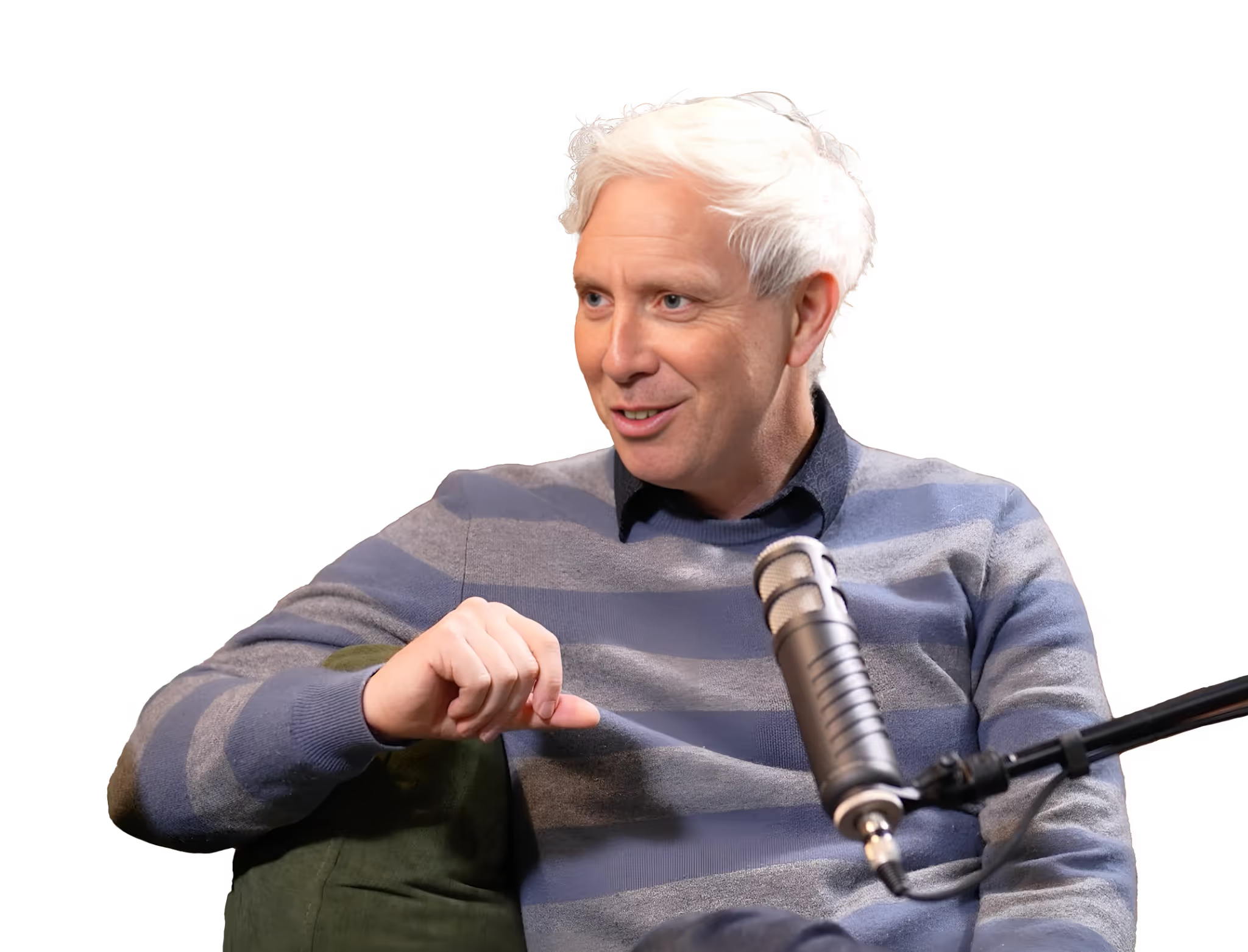
Peter Wrinch, founder of Uncommon Partners, is a dynamic leader in the social impact sector with a commitment to purpose and transformation. With a background as CEO of Hollyhock Leadership Institute and Executive Director of Pivot Legal Society, Peter has been at the forefront of change, championing legal advocacy, community development, and organizational renewal. Today, he guides social purpose organizations through strategic and purpose-driven journeys, helping them thrive in an era of rapid change.
Peter Wrinch [00:00:00]
What you get is these human dynamics at play because people are attracted to the mission. They're attracted to the purpose, they're attracted to the vision, and they're attracted by the people. And yet they still have to operate towards some form of outcome. And so I think this balance in social purpose organizations is a really hard thing to balance. And that's where purpose comes in.
Mo Dhaliwal [00:00:32]
Welcome to High Agency, igniting conversations with inspiring people, leading transformative change. In a world of increasing complexity and unprecedented challenges, the landscape of social impact is undergoing a remarkable transformation. Gone are the days of isolated efforts and traditional philanthropy. Today's nonprofit sector is challenged to embrace data-driven strategies, racing to keep pace with technology, and facing pressures that necessitate innovative collaborations to amplify impact. From artificial intelligence revolutionizing basically everything. Community-based organizations emerging as powerful catalysts for change, we're witnessing a fundamental shift in how social impact is achieved. So while demand for services soars and donor dynamics evolve, organizations are reimagining their approaches. They're blending business acumen with social mission, prioritizing diversity and leadership, and tackling climate change with a renewed urgency. But, amidst these sweeping changes, one question remains central. Why do this at all? The answer isn't so simple. Social impact organizations need to not just adapt but thrive in this new reality while staying rooted in the purpose that drove their existence. So today, we'll explore this question with someone who's been at the forefront of a few organizations with the intent to create transformative change. Peter Wrinch is the founder of Uncommon Partners, a consultancy where he brings his leadership experience to the social impact sector. As the former CEO of Hollyhock Leadership Institute and executive director of Pivot Legal Society, he's managed and driven change through legal advocacy, organizational development, and community building. Peter works with social purpose organizations on the deepest questions of purpose, drawing on his 20 years of experience where he led organizations, built powerful teams, raised millions of dollars and questioned every aspect of it. Peter, welcome to High Agency.
Peter Wrinch [00:02:34]
Thanks, Mo, it's great to be here.
Mo Dhaliwal [00:02:37]
I've been really looking forward to this conversation for a while because for years you and I have had many, many side chats about what's wrong with the world and what we're gonna do about it. But before we get into all that, I'm really interested in first hearing about what led you to this space at all, right? Like, what did you wanna do earlier in life? And did this align with it? Or do you sometimes look back and be like, how the hell did I get myself into this?
Peter Wrinch [00:03:02]
I definitely look back and think, how the hell did I get myself into this for sure. I think that it's an interesting question. I don't think that I had any design on how I would get here, or there certainly wasn't any sense like 20 years ago that I would end up in social purpose or that I'd end up having the skills to fundraise or knowing how to build teams. You know, I grew up in a suburb. In a lower-middle-class family, I think I really understood that I needed to do something with my life, but it was probably more on a material level than any sort of purpose. My mother was a schoolteacher, and there was a lot of focus on finding a job that really worked for you to build a stable life. I don't really think thatfitst with me from a very early age. And I remember having really intolerable conversations where I was intolerable with friends, saying things like, I want to be the wind when I'm older and things like this, um, which would like endlessly annoy people. Um, but I think for me, I came out of university, and then grad school and I was really focused on sort of two impulses. One, this idea that what we've built really doesn't need to be the way it is. That, that really is what we built, just the product of many people's imagination. It was never here before. It was really on a deep level. It is not what has to be. So that, and I found expression in that. In social purpose organizations.
Mo Dhaliwal [00:05:04]
Yeah, the imagination is interesting that way, right? Of everything that we take to be kind of chiselled in stone. I like to consider myself somebody that's imaginative and is able to think of different perspectives and what could be. But even I was surprised, for example, when COVID hit, right, because all of these rules that were chiselled in stone, suddenly it was like the tablet was smashed, right. And nothing matters anymore. And that was actually kind of a reinvigoration of the imagination for me. And maybe badly, but I was kind of a little excited by the chaos of COVID when it first hit. I mean, obviously, not happy that people were getting sick, the loss of life, the rest of it, but just the idea that for a brief moment, we could imagine society being fundamentally different and all of these hard and fast rules were out the window, and we're figuring it out again. And it seemed like there was a moment in there for something to happen. Absolutely, but within that, though, you also saw the human tendency to seek out safety and comfort, right? So even if systems are oppressive, they're marginalizing people, perhaps, not even optimal for humanity, we still wanted to retreat back into that because there was safety, there was comfort, there was a pattern there, right? And that's something that you have to deal with all the time. But maybe, let's talk a little bit about, you know, how you arrived at the point of actually trying to consult with social impact organizations. But where was your first real star,t where you said? Okay? Here's an organization. I'm gonna work with and here's the change We're trying to make
Peter Wrinch [00:06:37]
Yeah, before I answer that, I can't help but say one thing about COVID. So if you had told me... Six months before COVID, there would be some emergency in Canadian society and on a global scale, that would cause the federal government to underwrite the economy by 75%. I would have literally laughed you out of the room. That to me is to someone who's worked in politics to look to someone who's thought a lot about economics, thought a lot about the economy, the idea that a federal government in Canada would pay 75% of payroll to save an economy was just incredible. So I think your point is really real, like, and it feels like justifies my thinking as well that nothing is as it is, because it has to be that way. But to answer your question about consulting with social purpose organizations, I think that I spent 25 years working in social purpose organization from, as you said in the intro, as an executive director, as a CEO, but also as a development director, as a communications director, as an operations director, I had a short period where I worked for a tech company working on social purpose. I've been on boards, and the thing that I have come to see as similar across all of that is that these impulses and social purpose organizations to create something new to do something new, whether it's to tackle climate change, to get more youth involved in sports to, you know, de stigmatized drug use, whatever it is, it starts with this belief and usually a belief that connects a small group of people. And then as those organizations go on, um, the belief in roles, more people get more people excited. And then at some point, something happens. I've been involved in it on all the levels, um, where there's a moment where we start to compromise on that purpose. But that purpose is the power. And the more we compromise, the less powerful those orcs become. And so, for me, I'm 49 years old. I don't know how long I'll live. And I, I felt like leaving the world where I was the operator of those organizations to actually work with those leaders to help them. Connect to that deeper purpose that actually is their power felt really important to me.
Mo Dhaliwal [00:09:49]
You started, was it primarily at Pivot Legal Society, or was it before then?
Peter Wrinch [00:09:53]
Yeah, I mean, it's so interesting to think about that. I mean, I studied two things in undergrad, which was Soviet Revolution and Buddhism, totally unrelated, of course.
Mo Dhaliwal [00:10:04]
Yeah. And you know, both were solid career paths.
Peter Wrinch [00:10:06]
Yeah, very solid career process. No one told me that no one told me that there was no career involved in those things. I had the student loans to prove it. And I really think that is like Marxism and spirit, or politics and spirit, is a way of thinking about it. So I came out of university, and then I went to grad school, and I studied Soviet history. So I came out of grad school, and I was like. I had all these student loans, and I'm like, what the hell am I going to do with my life? Like literally, what am I gonna do with my life? I started writing all these cover letters where I was talking about Stalin and the Soviet 30s. And surprisingly, I got no callbacks.
Mo Dhaliwal [00:10:47]
And Starbucks was like, well, for an entry-level position.
Peter Wrinch [00:10:50]
Yeah, exactly. We're not sure this is going to work on the barista level. And so I spent a lot of time lying on the floor, going, what the hell am I going to do with my life? And I happened to apply to a volunteer organization. Volunteer coordinator role at this very new upstart called Pivot Legal Society in the Downtown East Side. And they called me back immediately. And I was so overwhelmed, so humbled that someone actually called me back that I, I went in for an interview right away. And the funny thing is, I went into this interview, and it was amazing. It was, it was these people who were doing amazing things. It's a small office; they all seemed like a startup, you know, not-for-profit social enterprise. I thought that I thought the interview went really well, and then they didn't call me back. And I sat there for three weeks going like, what the hell? I can't even get a volunteer role. And, uh, so I, I was really ready to give up. And then I just thought, no, I'll email them one more time. And the person got back to me right away and said, Oh, sorry, that person who was also a volunteer has left, but you would love for you to come in. And really, that's how I got my start. And within three weeks of taking that volunteer role, I was organizing Pivots volunteers, who were many at that time. I got offered a contract, and then the pivot went from being a one-person founder, not for profit, to five people. And I was there for 10 years.
Mo Dhaliwal [00:12:22]
And what did Pivot do?
Peter Wrinch [00:12:24]
Right. So Pivot was the thing that I think was a really strong offering that Pivot was making was that they were saying, Look. This neighborhood in Vancouver, which is Canada's poorest neighborhood, but is replicated across North America, you know, Skid Row in Los Angeles, the Tenderloin in San Francisco, different neighborhoods in New York, which had a lot of marginalized people result of colonization, results of economic policy, results of globalization, it really, the founder of pivot used to call like a flashpoint of capitalism. And so the offering that pivot made that was quite special is that they said, we're lawyers and communication professionals. We don't know better. We're actually going to interview the people who are living this marginalized life. Thanks. Take the stories that they're offering and take them as the experts. It's really like meeting people where they're at. And we will apply legal strategy, and we will sue all levels of government to shift society towards more equality. And so I came in, you know, with this grad study in Buddhism and Soviet history. And really saw the revolutionary impulse there. And so I was immediately working with our volunteers, as I mentioned, and then I took an operational role and then eventually a fundraising and communications role. And then the last four years, I was the executive director.
Mo Dhaliwal [00:14:08]
That's incredible. I mean, so Pivot must've established some legal precedents that must've fought some interesting cases.
Peter Wrinch [00:14:15]
Yeah, I mean, it was remarkable. Really. We went to the Supreme Court of Canada twice, and we had two unanimous decisions from the Supreme Court. But it was at that moment when we had those decisions, and they took 10 years to get there, you know, it's 10 years of work of bootstrapping of working with marginalized populations of fundraising of communicating, where I really came to understand that the theory of change was off with the organization. So we went to the Supreme Court and we had a win there for street level sex workers across the country and we decriminalized sex work in Canada and that was a time when Stephen Harper was the Prime Minister and the court gave the government six months to rewrite the laws that would protect street leveled sex workers and what the government did is they just came back and rewrote worst loss. And so, you know, I sat in the Supreme Court gallery with indigenous women from this community. And. And 10 years of work and 10 years of story and 10 years of fundraising, and came to realize that this legal strategy, which had so much promise, um, could not and probably should not overturn the will of the people. And so really you need to have a political strategy as well, which, um. Drove me to leave Pivot and actually start working in politics, because I was like, you cannot have this legal strategy that can create these tremendous wins. But if without the political will, without the political, yeah, exactly. Without the political will, you'll just have those winds eroded by a parliament. And that is probably right. You know, this balance between the court system and parliament. And what I would say is that what I came to recognize from my tenure as a pivot is that the most important thing was actually sitting in the Supreme Court with those indigenous women, the moment that they got to tell their story to the highest court in the land, even though it was overruled by, um, by Parliament.
Mo Dhaliwal [00:16:45]
That's heartbreaking. Yeah. I can only imagine putting a decade into something and having it go so badly.
Peter Wrinch [00:16:51]
Yeah. I mean, it's... I think for me, it was really clear, and it spoke to me about something that I think still permeates social advocacy space andnot-for-profitt space, which is, you know, when I started working at Pivot, I've realized this recently, I have a bit of a romantic view. You know, maybe it's Buddhism. Maybe it's like romantic Marxism, but. I was more of a romantic, and so the tactical, the very... Hard-driven work of politics seemed a little too mercenary, exactly mercenary, a little too I don't want to use the word toxic, but a little too tactical. And many people that I worked with or advocacy work had that same view that politics was in some way broken, um, that there needed to be a third way. Sometimes you would hear this conversation, but in a third way. But what I came to realize, through those Supreme Court victories, and then having those decisions, that decision in particular, not overturned, but the laws written worse, was that you can't ignore electoral strategy. It has to be part of the tool belt. And so that's why I went out to work in politics.
Mo Dhaliwal [00:18:30]
I've had some experience in the social impact space and founded a couple of different nonprofits. And for me, originally, the social change and impact I was trying to create was frankly, just to create space for myself and others who have my lived experience, looked like me, walked and talked like me, came from similar communities as me. And it was actually after I'd moved back here from California in the early 2000s. So early on, I also think kind of romantic. I believe that a small group of people can change the world. To some extent, I think that's still true. But we started, you know, a lot of cultural production, right? So, you have Punjabi folk music and dance festivals. And it was an interesting thing for me because I never considered myself a social impact person. I wasn't, you know, but there was the thing that you want to see, and there's nobody else doing it. So you just get started on making the change. Yeah. And I would say till today, like most of what I learned about human dynamics, politics, and how to make things happen was actually through what was also a startup, non-profit, right? Which isn't for the faint of heart, right, because it's hard enough running a business and trying to sell a thing, and non-profits, you know, you're trying to sell an idea, right. Concept and intention. And working with donors, sponsors, and funders of different types. And what I encountered in that space was that there's a lot of human dynamics at play, which can be incredibly beneficial, but also sometimes kind of lean into the damage and the toxic, right? And some of it's true for myself as well. So I'm not saying this in a judgmental way, but I think working in social impact, what I discovered after about a decade of just starting my own nonprofit and helping it grow was that some of the attraction... For myself, even, it was about wanting to have some access to like the agency of being able to feel like you're in control of your life and your environment. That's right. Right. And what would happen is over time, you'd also wind up attracting a lot of people, frankly, that perhaps had some demons, right? But we're looking for some place where they could feel like they mattered and they could affect something. And perhaps that's born out of this feeling that actually the world, the society we live in, we have no control, right? That, in fact, we are disenfranchised. And so a lot of these spaces wind up attracting a lot of people who just want to hang on to something where they feel like they've got meaning and they can make a difference. Because in wider society, perhaps you feel like, you know, you don't.
Peter Wrinch [00:21:11]
Oh, Mo, there are so many things in there. There are so many things in there, so the first thing that came to mind when you said that is I think everyone has demons, and I think that we play out our demons in different ways, and definitely the communities that we end up in, whether it's work, social, or otherwise. I think that I've really started to think about this recently. So there's almost like these two sides, and there's probably multiple sides, but there's like this community of practice that often shows up in social purpose organizations. And then there's the drive for impact or whatever you want to say. There can be a crass view of it as a product or an offering, which is another way of saying it. But I think that they work together. There's this community practice. So whether it was Pivot or Hollyhock, or even Nation Builder, the tech company I worked for. There was an attraction and enrollment to bring people into this community of practice. We're doing a thing, um, that maybe no one else is doing. We believe that we have a unique offering and the offering is towards a towards an outcome. But really, what matters is this, this day-to-day community of practice, this day-to-day way of relating. I think the challenge often with social purpose organizations is that they're on. Um, and I, I've been an advocate for this often. Um, they, they've taken on, um, some parts of the business world. So this, this outcome measurement, this, this drive towards, um. A thing, you know, outputs, um, they're often fundraising based on that. And yet they all also offer this home for people who have shared beliefs, you know which. You know, in the businesses you've run, there is obviously a shared belief, but in a lot of businesses, there is not, you know, the shared belief is a return to shareholders or whoever is to drive the money upwards. And so what you get is these human dynamics at play because people are attracted to the mission. They're attracted to purpose. They're attractive to the vision, and they're attracted by the people. Yet they still have to operate towards some form of outcome. And so I think this balance in social purpose Organizations is a really hard thing to balance and that's where purpose comes in I think that if we can be really clear about the purpose and make it a living purpose so that it lives, not just, I mean, people say this all the time, but not just as mission and vision statements on the wall, but it's like in everything we're doing, we're living this purpose in the way we treat other people, in the way that we write our employment contracts, in the way that we enroll people, in the way that we fundraise. These are all the things that really matter. To a purpose-built organization that is so much more than, you know, corporate social responsibility, these types of things. And I think that that is the direction we're going. But those dynamics are so real and so deep, and often can be. Can feel heavy. You know, I recently and by recently, I mean the last four years, have really come into working with the Enneagram. And so the enneagram is a system, it's like a personality, for lack of a better term system, sort of like Myers-Briggs. But it shows, you know, your generative state and your stress state. And so I identify in the Enneagram 3 category, which has this real drive towards you know, achievement and most of that's built out of my own fear of failure and I'm worthless and am I worthless in the world and oh my god, I have to do this thing and so I have to achieve and that's how I'll have value in this universe. And I think that the Enneagram three energy, and there are lots of different things you could call it, towards achievement and driving and impact, is real is a really important energy. But there's also this Enneagram nine energy that is more about finding common ground, finding, building these communities of practice, seeing things from multiple different angles, that in my earlier career, it would drive me nuts. I'd be like, what do you mean we have to contemplate how we're doing this? We're just doing this, let's just go. But I've come to really A, depersonalize that energy, so I'm not looking at someone and going, Why the? Why the hell is this person getting in my way? But instead, just going, oh, right. Yes, Peter, you have these ideas for driving forward, but actually, this other person is bringing this more nuance, this more thoughtful energy. Let's engage this a little bit because let's not engage it to stop us, just to make it, to make nothing happen, but let's engage it so that we don't go out in the world and really put our foot in our mouth or do something that's gonna create harm. Upstream or downstream
Mo Dhaliwal [00:26:40]
And I think sometimes that energy, the more methodical, the planned energy, I'm not familiar with any ground, but I'm very familiar with the behaviours that you're describing. I feel like I'm still challenged by these days because I'll have what I think are fantastic ideas. And I want to see them implemented yesterday. Immediately. Yeah, immediately. And I work with a managing director who is very pragmatic, she cares about people's feelings and budgets and things, which is important, right? So there's a constant resistance. Um, but sometimes it's also challenging, understanding whether that's a useful productive resistance that's going to, you know, kind of put some structure, like give a, you put the flame inside a lantern so that the light can be protected or whether it's, um, I sometimes, you know, and this is from, um Salim Ishmael, um he described new ideas entering an organization as sometimes being regarded as a pathogen. And the organization will send in antibodies to kill off the pathogen. That's right, inoculate against the new. Yeah. And so I've sometimes also had a challenge myself with recognizing whether it was that sort of, you know, productive structuring energy. Yeah. Or whether this was just, you know, organizational antibodies coming in to, you know, kill me off as a pathogen, right? Yeah, yeah. And that's a struggle. Absolutely. And it's especially, you know, so in organizations, I think, that have been around for some time. Because, as you know, we're speaking in the context of Vancouver. Um, you mentioned Pivot Legal, downtown East Side. We've had a number of charitable organizations that, you know, had some controversy, made the news over the past, you know, many decades because of the fact that they were there to take care of a population, to bring healing, to, um, help them come out of poverty, help them come up with addiction. And what's happened is that entire sort of area. Almost kind of became its own economy. And these purpose organizations kind of become self-perpetuating. And like I can't speak to, I was never a member of these board meetings or where the decisions were being made. But even just looking at it externally, it's like you have a stated purpose and you're meant to heal, help, house this population of people. But when you actually look at why you been controversial, where the funding's gone, what's been going on with you. It seems like at some point, the focus kind of flipped into we need to make the nonprofit really well funded. We need to pay a lot of salaries. We need to kind of become top-heavy. And that purpose thing, that impact thing, yeah, if it happens, it happens. But like, you know, we've got bills to pay, right? Oh Just like playing with a little nerve there. Yes, you are. I don't think that happens overnight. But there is something that, over time, sends even a purpose-based heart-centred organization towards that. And it's the tension of saying we need to create an impact, but in order to do that, we need to corral and marshal resources. And then eventually it's just marshalling resources. Yes. And I'm going to... Reference something you wrote on LinkedIn recently. Yeah. And it was a great article, and you gave me a bit of a cameo in it. Thank you for that. You're welcome. But I thought it was just a fantastic sort of allegory where you talked about the rolling. Actually, I'm not gonna do any spoilers here, but it's, you basically talked about social impact organizations and the Rolling Stones. Yes. So, let's... Let's tell that story.
Peter Wrinch [00:30:20]
Yeah. I mean, Mo, there's so many things you just said that are, are so, um, I think that one thing I, I'm I've really come to be more comfortable with is that there's all these tensions in the world that exist and that it's very important to be able to hold those tensions and to see them and to not jump into And I have to measure this in my own self, jump into a sort of European enlightenment, like there's a solve here, there's solve here. I think that I just want to make one comment about the Downtonese side and what you were saying there, because for 10 years I worked in that neighbourhood. I worked with amazing people who were so meaning-driven, they so wanted to see real change. And I think that, you know, I go back to the founder of pivot, John Richardson, when he used to say that the down to any side represents a flash point of colonization and capitalism. And you can't solve that problem with more colonization and capitalism, exactly with more colonization in capitalism. And you can't solve it like Vancouver can't solve it, British Columbia can't solve it. Possibly, Canada can solve it, but it requires such a coordinated effort. But it also requires, like, really leaning into shadow. What does that, if that's a flash point of capitalism, why is it so? And why, what shadows of capitalism live inside of all of us? Are we living the lives that the universe intended for us? I mean, not to get too left coast woo, but are we living the lives of the universe? Intended for us is just the way. And it comes back to that first comment is the, it are the, are things the way that they are because they're the way that they should be, you know, these are big questions in that neighbourhood. It's not, it's not simple, you But yes, so. When I think about purpose and how purpose erodes, I couldn't help but think of Mick Jagger, and I'm not sure why. I'm sure why Mick Jaggar just kept popping into my head, but I just thought it. I think I've been struggling with Mick Jaggar for years, quite frankly, with this idea of a rock star, and I use that term so lightly. At 80, is that really what that is? And so for whatever reason, I've been, you know, really thinking about purpose recently, and I just kept having Mick Jagger in my head. And so this idea that. The other thing I've been really fascinated by recently, and bear with me here. Hold on. Hold on, absolutely is the big bang. And so you have this big bang, and I don't know much about it, but what I do understand is that it's energy pushing out from a center. And so we are all representations of that energy. And at some point, all organizations, all organizations in the downtown East side, all environmental organizations, all organizations across Canada, social purpose organizations, and many businesses started with this, an idea probably around a kitchen table or, or, you know, a fire somewhere that we could do a thing and that we're, we're the ones who can do this thing because we have something special. And to me that's, that's like grabbing that universal energy that's still expanding from the Big Bang. But I can remember this moment of pivot when I was the ED I was sitting on a beautiful couch like this one, donated by a wonderful man named Toby. And I was looking out across our open concept office, much like this, and I was ED, and I thought, oh my God, every single person in here is doing amazing work. And I need to make sure I can raise enough money to keep them all doing that amazing work and so there's this tension that ED is getting where they're like I know that I need to be a visionary leader that holds purpose like the flag of purpose, but I also need to make sure that all of these people who I believe are instrumental in driving that purpose stay employed. And oh, by the way, we live in a capitalist system that is constantly trying to poach these people for way more money than we can pay on our nonprofit salaries. And so I have to be constantly working this angle to increase salaries, to increase benefits. A challenge that I've often found at not-for-profits and social purpose organizations, advocacy organizations, is not that people want to work last. So, you know, there are these people who believe that people wanna, you know, if they work from home, they're not really working. My experience in every single social purpose organization I've ever worked in is the exact opposite. You actually have to find ways to help people stop working, like putting in boundaries. And so they're also burning out. So you have, so for me, it's always been, it felt like a fundamental responsibility as a leader of an organization to make sure that we hadthes best health care that we could provide to pay people the best salaries we could provide, which are always, um, not good enough. And so this push towards trying to be like a capitalistically competitive. Yeah, exactly. While, while holding purpose. Is a tension that I know keeps EDs up at night all the time. It kept me up all night for the last 20 years. You know, it's why my hair is the colour it is after seven years at Hollyhock. It's how do we raise salaries? And hold purpose while not bloating out our admin so that we just become a shell of ourselves. And I think that this is. The reason why executive director and CEO jobs in social purpose organizations kind of sucks. It's really hard. And I love when there are funders, and there are more and more, and they are starting to really understand this. They're starting to really understand that these organizations are their people. And I know I'm going on a bit of a rant here, but one of the things that I'll say is that it was a major realization coming back to COVID for me. You know, when COVID happened in 2020 at Hollyhock, we shut down all of our programming. Never in 42 years had that happened. And the history of Hollyhock is a lot of ups and downs, but it has never cancelled its programming.
Mo Dhaliwal [00:37:28]
So, Hollyhock is a leadership institute in British Columbia; it's a retreat center, it runs programs, and it works with many partners, so it's a very in-person activity for people to come and experience some level of transformative change. But if you're not in person, or if you are not in person...
Peter Wrinch [00:37:43]
Yeah, then what are you? And for 42 years, it had, you know, run somewhere between 60 and 100 programs in a six-month season on a remote island 300 kilometres north of British Columbia, or sorry, north of Vancouver, which required travel, which required intimate spaces, which required people getting to know each other, meeting each other. And all of a sudden, March 9 2020. We come to the realization that that's probably not going to happen this year. And we have a staff of, uh, we had a full-time staff of about 25 and we had, um, seasonal staff that brought that full time, full time number up to 85. And I came to the, and I came into the realization that basically we were not going be able to hire all those people back, but we are also not going to be able to. Close completely. And lay off everyone because what actually matters at this time? Cause I had no idea. And you remember the beginning of COVID, we're spraying our groceries. Like we had no idea whether we were all, anyone was going to make it through this, but I just knew, leading through values and purpose, that we had to keep our people together because what if all that external impact didn't matter? What if the only thing that mattered was the way we treated each other day to day? That community of practice. And I think that those two tensions between, like, this community of practice of how we treat each other day to day, how we pay our people, what kind of benefits they have, what kinda work, um, what it feels like to go to work. What if that is as important as this external impact that we're chasing?
Mo Dhaliwal [00:39:37]
You were at the Hollyhock Institute for seven years as the executive director. And I know that, you know, from our conversations, um, you, you, the CEO, executive director, challenge and tension that you're describing, you felt that a lot, right? Because you're trying to drive, um, change and ensure that people who run their programs and, uh, arrive at Hollyhock for all of its promise, um, feel that and get that while also maintaining relationships with funders and owners. I'm sure we all have our own opinions about how things should happen. And, you know, donors tend to have a lot of ideas, right? They do, yeah. Especially major donors. So, you know, why did you make the decision to leave, and how did you navigate that for seven years? Yeah. And we're gonna bring it back to Mick Jagger after this because you went 13 billion years ago. Yeah.
Peter Wrinch [00:40:27]
That's right. So one of the things I'll say about Hollyhock in seven years is that I had never experienced as much generosity from donors as I did at Hollyhock. You know, I was a person growing up, and I didn't know any wealthy people until I went to undergrad. And then, you know, I started meeting wealthy people when I was working at Pivot. But the level of generosity I saw at Hollyhock was remarkable because there's something that Hollyhock does. There's something that all of these centers do that is a deep transformation. I mean, I sat on the deck at Hollyhock almost every day in the summer for seven years. And I heard the conversations that people were having. You know, things like as adults, we never get time for this. This is the best thing I've ever been to. I can't believe the friendships I'm leaving with. I can believe the insights I have, the new businesses I'm starting. I mean There is such a deep transformation happening there. That to make the decision to leave something like that is very hard. And it took me a long time, a lot of grief and a lot of moving back and forth through that decision. One of the things that Hollyhock did teach me is, is, um, you know, again, I'll go back to this any Graham three energy. Like, I'm a very strong narrator. I near I think I narrate with my head. I don't really feel my body. I'm very like you writing in that way. Like, I'm very disconnected. Um, I once had an indigenous mentor, and she said, um, and this was not, she wasn't dissing white people, but she said we had a word for, for Europeans in our language, and it just translated to disconnected. When she said that to me, I mean, I've been thinking about that for seven years. Like that really hit me deeply because I was like, Oh yeah, like I'm, I'm actually really often disconnected from my experience of the world. I can narrate it, but I'm very disconnected. And so last year in November, I went to New York City. I was a little tired. I was a little irritated that I was there. I don't love New York. Um, and I was walking around doing donor meetings. I was, I was meeting with donors and, um, I got there, and I was like, OK, well, you're here, man. Like you just got to like, just you're here. Yeah, I just do it. And so I made this decision just to walk around. I was just like, I'm not going to take Uber. I'm going to the subway. And so in four days, I walk 70 kilometres. I had four donor meetings across the city. I learned to really love New York. Walking in New York is amazing. But I had this really strong body sense. I was just like it was like my body was just telling me. Very clearly that I had to move on from Hollyhock, that I and that this was a purpose move for me, that I at 49 am no longer. I no longer should be the CEO of these types of organizations. I have to work with these leaders. That is my purpose now. And this was a body realization. And I'm not good at listening. Like, even when I was getting the body, I was like, come on. So when I got on the airplane on my way home, I actually typed out my resignation letter because I was so clear that I would chicken out as soon as I got home. I would just be like, no, I would narrate it away. And so I gave my notice in February, my last day was July 31st. I had an amazing colleague and friend, Heather Deeth, who was our chief product officer at Hollyhock, who is now the interim CEO, and they're looking for a new CEO. But for me, this was a really strong purpose move. And I'll tell you one other weird thing that happened to me. So, in this podcast, I'll use the word purpose, but the word I was actually using was the word Dharma. And, you know, Dharma comes from Sanskrit. It's through Indian traditions, through Hinduism, through Buddhism, through Jainism, through, you know, it's part of Indian religious history. And so I was really, I was using this word Dharma, and so I went to a conference in April in San Francisco, and I got into the hotel, and I’m in my hotel room, and I put all my stuff down, and I opened the blind and on a building, a huge sign that said Dharma. It was like the Dharma college or something, but I couldn't see the word college. All I could see was Dharma. And so I'm really for me, my purpose journey is about really knowing where to look. I follow this meditation teacher named Light Watkins, sort of a little pop, a little pop meditation, but Light Watkins is a brilliant teacher. And he talks about knowing where to look. And so that's part of what I think I'm going through on my own purpose is just understanding that there are tons of messages in this world. And if you start to open up to them, they're there for you. And so, that's kind of what happened to me in New York City.
Mo Dhaliwal [00:45:24]
That's incredible. What you're describing is pretty much my lived experience as well. I've got, I think, really good friends, advisors, coaches around me, and the constant advice I get is to explore somatic therapies, to get into my body, because I also very much treat my body as just transportation for my head, basically, right? It's the thing that carries my brain around. And most experiences for me are cerebral. And like six months after I have an emotion, yes. I was like, oh. That was, that was the feeling I was having back then. Totally. But, you know, so you, you have this embodied feeling, you, you left Hollyhock, and now you're essentially, uh, consulting with social purpose, uh, you know,w imp withct-focused retreat centers, organizations, and, but what are you trying to do with them?
Peter Wrinch [00:46:17]
Yeah, well, that's a great question. I think that part of what I'm, and I'll just be honest, I'm nudging towards, I'm not doing towards an offering, but what I can tell you is in the last three months, I've had some of the most remarkable conversations that I've ever had, because what I am trying to do is help organizations get to that honesty about where they are. From my own lived experience on both sides of that. You know, I've been in that startup phase of organizations. In fact, before I worked at Hollyhock, every organization I worked at was in that start-up phase where you're standing, you're sitting around a kitchen table or a used boardroom table or a fire, and you're talking about purpose. This is why we're doing this thing. And the question is, how do we bring this purpose to life? And that includes how we communicate about it? How do we fundraise? How do enroll more people in it? How do staff it? And I've also been in organizations where you start to tip towards over-administration, I would say. And I don't come by this easily. I think the balance is really hard. And so what the conversations I've been having with. Organizations are to really help them find that enthusiasm, find that life, find that like, you know, big bang universal life force that they had at some point, or decide that it's time to die, that it is time to hospice, that its time to wind down, we have a lot of words for this, but that it that it's played its role. You know, sometimes I think about that in some of the organizations I've been part of, that they were started with a great intensity, with a great passion, with a great drive. And sometimes they, they've served their purpose, and they don't need to continue. I was talking to someone a few months ago, um, and there are some of these funders around now. They don't fund organizations anymore. They just fund campaigns because of the campaign. Is more important than establishing an org and it's got a focus and intent, and it's kind of beginning and an end. That's right. Yeah, that's right, and that's hard. I mean, that's hard. Um, you know, one of the other conversations I've been in quite a bit is with foundations that are spending down, you know, there's a lot of foundation spending down because they recognize the, um, the regenerative moment we're in or the poly crisis. There are lots of ways of talking about it where you have, you know, existential threats like climate change and inequality and, and Trumpism and fascism. Um, and they're spending down. This is not a time to hold money in an endowment. You know, they're spinning down. And one of the conversations I find most fascinating in those is I often am like a little sheepish or looking down when I say it, but I'm like, what about your jobs? And they, and I'm so enthused that people actually have answers, and they want, oh, yeah, like, no, we understand that our jobs will end at the end of this endowment spend down. And so I'm really interested in how foundations and philanthropy are activating not just the interest in their endowments, but their endowment, because they recognize the existential threat.
Mo Dhaliwal [00:49:56]
That also seems to be a realization of. The natural sort of inertia and malaise that a lot of organizations can settle into after some decades of working on some sort of movement, right? Yes. And I'm gonna reference Charles Hugh Smith, who outlined the life cycle of bureaucracy, he called it. And it was fantastic because I saw myself in it and the organizations I've been a part of. I know it really resonated with you, but where he started was basically in this diagram. Depicted the launch of an organization, right? So it's this big blue circle, which is all-purpose. And the center of it is a little green dot, which is the bureaucracy. And that's the launch period, right? It's all-purpose and a little bit of what we need to get it done. And then there's a growth period where you're still working on purpose. It's still mostly blue circle, but that green dot's a little bigger because we're in a growth phase. So we're hiring staff, we're getting more powerful at what we're doing. And then, there's the maturity that he describes as basically being kind of like 50-50, right, it's like there's. Blue Circle's purpose, but now there's a pretty big bureaucracy that is holding it back as a mature organization. But in your article, you actually extended it. And this is, I think, where we really saw a lot of organizations that we've worked with in the past, where there was a period of bloat, where administrative costs kept rising. The blue purpose is still there, but the green center is quite large now, right? There's a point of reduction where perhaps your organization's going through some sort of crisis, perhaps leadership has left. Now the administration is trying to hold on to the organization, which takes their focus off purpose to a large extent, right? And now that the blue circle is even thinner, the green is even larger. And then what you described as a zombie organization, which is the way you said, the purpose is a farce, and now it's all bureaucracy. And the purpose is like this fine blue membrane kind of sitting around that center. And that's the sort of place where the organization's not dead. But it's just kind of lurching forward, and it's trying to be self-perpetuating, right? And I think it was that type of organization that I was referencing and talking about some of what we've seen with organizations that operate out of the downtown east side, not questioning any of the passion, commitment, and heart that many people bring to their roles, but that this bureaucracy at some point kind of becomes self- perpetuating. And so it is pretty encouraging to hear that there are foundations and organizations out there. That can actually contemplate their own demise. That can actually say that that could be a regenerative thing that we need to build into this. And how do you communicate that? How do you go in as a consultant and basically be like, yo, I want your organization to die, and here's when it should die.
Peter Wrinch [00:52:44]
Yeah, it's not very popular. I think like, you know, this goes back to what we were saying when the joke you made at the beginning about like I'm studying Soviet history and Buddhism, you're like, not really strong career paths. I'm not sure this purpose thing has that either. Because yeah, no, it's not very popular when you tell someone they think your organization should die. I think that, you know, what I... lights me up or gives me hope about this is that when organizations get to that thin membrane of purpose around a bloated, internally dead administration, no one's happy, no one wants to do that. And so, I think that that's where the opportunity lies. And use this word regenerative. I think that's the opportunity that we have right now. So there are a number of organizations and ways of doing things that need to regenerate. They need to be composted. They need to be recycled, whatever your metaphor is. Why they hold on is actually like, so one major insight I've had here is that there are very rarely bad actors in these organizations. They all, it's a lot of good people doing a lot of good things, and they all want life force, and they want energy, and they often all really believe in the purpose, but they're weighed down by what they can see happening, which is talking about purpose, but purpose not arriving or purpose not having any outcomes. And so it creates this thing that I've really started to see is this incoherence. You know, I was talking to an organization recently or a couple of months ago, and I said to the person, I said How would you feel about being the person who composts this organization? Like, like, how's that going to feel for you? Not necessarily about impact or anything, but just, can you be that person? They were asking me for my advice and if I could help, and all these things were in it. And I didn't see a path. And there's something liberating about that for that person. I mean, it's terrifying. And I've been, I've had many sleepless nights about being the person who has to compost an organization, and I've had friends go through it. And I've seen things. Happen, it's devastating, you know, it's devastating. But I think that we're at a point now, with a lot of sort of organizations that were formed in different times with different realities, that are asking these questions or should be. I was talking to someone else a few months ago, and they said they were talking about their organization, and they were saying, we've basically just become an arm of government. And I was like, Oh my God, there's something you basically couldn't say anything worse. You know, if you're trying to be an advocacy organization, I mean, you know, I'm a big fan of government, mostly. Um, but if you try to be in an advocacy organization and you have the tone of, of government, um, there's probably a lot of purpose work that needs to be done there or composting. And that's okay. It's just that, how do you transition this whole community of practice into something else, which I think is, is the fear that Edies are walking around with, um, that not a lot of people talk about, or they talk about in needy peer groups, but not publicly.
Mo Dhaliwal [00:56:32]
Sounds to me like I haven't done the research around it necessarily, but it just seems like it's so necessary and is likely the largest gap in a lot of these impact spaces. You know, there's that Steve Jobs quote where he says that death is nature's best invention. Totally. And we're all going to die. Absolutely. Right. And it is necessary. Yes, we are. And we wouldn't evolve without that. Yeah. But we do start companies and organizations, and we just don't even perceive their end. For some reason, and maybe it's a discomfort with our own mortality, I don't know, but the mortality of an organization does need to be addressed. So why do you hate Mick Jagger?
Peter Wrinch [00:57:12]
So let me just say one thing before I get on to Mick Jagger again. When I was at Hollyhock, so Hollyhock is on 48 acres of beautiful second-growth forest on Cortez Island, a beautiful island, up island, Vancouver Island. I spent a lot of time walking in the forest, and I would use it as a metaphor. It is a very popular metaphor to use at Hollyhock. And one of the things that I came to realize, I think I was born in a suburb. I grew up in cities, but over the last 10 years spent a lot of time in the forests. And I think that I often thought forests were places of life, like that they were alive, and certainly they are, but they're also places of death. And I think that when you're in a forest, and you look around, you know, again, going back to like Watkins and knowing where to look, you see all the cycles, the new, you know, the beautiful cedar trees here on the west coast that have their babies beside them. But you also see the dead cedar that those ones are growing on top of the nurse logs. And I think that to your point exactly, like we create these organizations that were created in conditions, and we assume that they will just go on forever. But they shouldn't. Like, I fully believe they should not.
Mo Dhaliwal [00:58:42]
Well, especially if you're an impact organizer.
Peter Wrinch [00:58:43]
Exactly.
Mo Dhaliwal [00:58:44]
Because you would hope that you've changed those conditions.
Peter Wrinch [00:58:46]
Exactly, you know There's that like famous idea of in Marxism that you know, you eventually You know the party eventually becomes irrelevant because you have classless society, you never worked out but You know, if you're driving, if your only outcome, the only outcome that you're looking for is shareholder profits, then you should maybe continue on indefinitely. But if you actually want to change the conditions by which you started to change, then maybe the better way of looking at social impact organizations as it is as campaigns. Now, I'm not sure about that. I'm saying it like I'm very sure, but these are the things I'm thinking about. But coming back to Mick Jagger, so. When I was growing up, I was a Beatles kid. I really enjoyed the harmonics of the Beatles. And the Stones were always a more dangerous version of the Beatles to me. But I had the greatest hits albums. I was more of a greatest hits guy. But I think at some point, as Mick Jagger continued to dance around on stage. I started, you know, I've been to a Stones concert. I think I went to the Voodoo Lounge Tour in the 90s, BC Place. But the more I sort of watch the Rolling Stones, the more cringeworthy I feel. And this is all to say that there's something wonderful about the idea that they are still doing that. But how dangerous are you as an 80-year-old rock star? Exactly, like there's a lot of danger. There's a lot of danger. There's a lot of like, clearly it is a moneymaking machine. Like, there's not a lot of purpose. I'm not saying that there aren't any, and there are occasionally good songs. But that is to me the archetype of something that started with creative passion. I mean, these guys, young men, young white men coming out of London wanted to, you know, really get into R&B music and really wanted to bring that to you know, the white world, they clearly had a lot of passion and creative energy. And you can really see that in the late 60s, early 70s. And then it just all turns to excess, in my opinion. And so, you know, maybe it's just a really easy target. I, you know, still, you know, one thing in writing that piece, I really enjoyed actually learning a lot more about the Rolling Stones and listening to their music. But so I don't hate Mick Jagger, you know, I don't want any haters. But um but I It's definitely a bit embarrassing for me, for everyone involved, in my opinion.
Mo Dhaliwal [01:01:33]
I just love the metaphor because, you know, for the era that they began in, like their sort of point of genesis, they would have been that creative, dangerous energy and a force for change. Absolutely. But for a period. Right. Exactly. And after that, they became a machine. Yeah. And now they're very much a corporate entity. Right. Totally. How much change are you creating? You're not dangerous at all. In fact, you're quite innocuous, right? Exactly. But you've got a great following, and you've figured out how to basically become self-perpetuating. Yes, exactly. So the Rolling Stones and their moment of change were probably for a couple of years. That's right. 60S, 70s. That's Right. And since then they've been... In this corporate mechanism.
Peter Wrinch [01:02:13]
That's right. And somehow, through circumstance and personalities and possibly Yoko Ono, the Beatles ended in 1970. Of course, John Lennon was assassinated in 1980. And so they can never be again. And in a way, that allows them to live in this space of perpetual creativity. White Album, Abbey Road, Let It Be, the end of the 60s and 1970s. And yet the stones are able to continue, even though they had deaths and they had tragedies, but exactly, they've just become Rolling Stones, Inc. You know, and I think that this is the challenge with organizations as well. Because I've been there, you know, both in sales when I worked at a tech company and in fundraising, everyone loves getting the million-dollar donation. Everyone loves getting that $10 million donation, but what's the cost? What are the costs to your purpose? And how do you, when you start enrolling people, when people are enthusiastic about the solution or the thing that you have, how do you remain grounded in purpose? And, to me. This idea that's coming through really strongly right now in all these conversations I'm having is that it has to be an embodied living purpose.
Mo Dhaliwal [01:03:35]
You know, I'd be interested to find out how many artists, creatives, musicians cite the Beatles as being an early influence versus the Rolling Stones. Yeah, totally. Because death is quite interesting, right? Because when that thing has made its impact, it's inspired you, and it's left, perhaps it creates a lot more room for you to actually imbibe that influence and carry it forward in some wonderful way. Yeah. Whereas I wonder how many musicians or artists are out there right now that would actually cite the Rolling Stones as an influence. I'm not sure.
Peter Wrinch [01:04:07]
Well, it's hard because they're here. They're there. Exactly. They are there. And and and so if you say the Rolling Stones, you know, what I've heard people say over the years is I've been engaged in conversations about music, is early stones. They often say early stones, you early stones.
Mo Dhaliwal [01:04:21]
Yeah. Epics and eras.
Peter Wrinch [01:04:23]
Yeah, exactly, early stones. They're not talking about Voodoo Lounge. They're not talking about a bigger bang or whatever terrible albums they made in the 90s
Mo Dhaliwal [01:04:34]
Well, Peter, thanks for coming to High Agency. This was a great chat. I really appreciate it, man.
Peter Wrinch [01:04:39]
Yeah, thanks so much, Mo. This was so fun. And I love the work you're doing here.
Mo Dhaliwal [01:04:43]
Alright. Thanks, man! Thank you. Well, hopefully we've given you a lot to think about. That was High Agency. Like and subscribe, and we will see you next time.

Get our latest insights on brand transformation and digital innovation delivered monthly. Join forward-thinking leaders who are building momentum.
We’re ready when you are.